
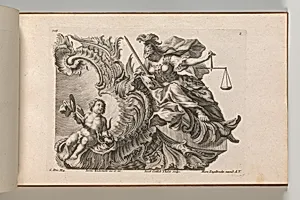
Design for a Rocaille Cartouche with the Figure of Justitia, Plate 2 from an untitled series with architectural cartouches and allegorical figures
Printed ca. 1750–56
Medium
Etching
Dimensions
Overall: 8 7/16 × 13 3/4 in. (21.5 × 35 cm)
Classification
Prints|Ornament & Architecture|Albums
Department
Drawings and Prints
Museum
Metropolitan Museum of Art, New York, NY
Credit
Purchase, Daniel Ergmann Gift, 2014
Accession Number
2014.97.16
Rights
Public Domain
Tags
Art Historical Context
This enchanting etching, titled *Design for a Rocaille Cart with the Figure of Just, Plate 2* from an untitled series was printed around 1750–56 by a collaborative team including Jacob Gottlieb Thelot, Martin Engelbrecht, andemias Wachsmuth.oused in the Metropolitan Museum of Art's Drawings and Prints department, this 8 7/16 × 13 3/4-inch plate exemplifies mid-18th-century ornamental. At its center stands Justitia, the Roman goddess of justice, poised within an elaborate rocaille cartouche—a scrolled, shell-like frame brimming with playful putti (cherubic figures) and sinuous snakes, evoking abundance and whimsy. Rocaille style, a hallmark of the Rococo movement flourishing in Europe during the 1750s, emphasized asymmetry, natural motifs, and lavish decoration, contrasting the era's earlier Baroque grandeur. These prints from Augsburg-based workshops like Engelbrecht's served as pattern books for architects, silversmiths, and cabinetmakers, disseminating fashionable motifs across courts and bourgeois homes. Etching's fine lines allowed precise rendering of intricate details, making such designs reproducible and widely influential. Justitia's allegorical presence underscores Enlightenment ideals of balanced justice amid ornate fantasy, blending moral symbolism with decorative exuberance. A delightful glimpse into Rococo's playful elegance, this plate invites visitors to appreciate how prints bridged art and everyday luxury.
About the Artist
Jacob Gottlieb Thelot|Martin Engelbrecht|Jeremias Wachsmuth (Central European|German|German) · |1700 |1684 – |1790 |1756
German, Augsburg 1708–1760 Augsburg|German, active Augsburg, ca. 1750|German, Augsburg 1684–1756 Augsburg