
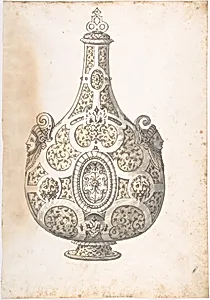
Design for a Silver- gilt Flask Decorated with Strapwork, Masks, Moresques
16th century
Medium
Pen and black ink, brush and gray and yellow wash over black chalk
Dimensions
16 7/16 x 11 7/16 in. (41.7 x 29 cm)
Classification
Drawings
Department
Drawings and Prints
Museum
Metropolitan Museum of Art, New York, NY
Credit
Bequest of Harry G. Sperling, 1971
Accession Number
1975.131.70
Rights
Public Domain
Tags
Art Historical Context
This exquisite 16th-century drawing Erasmus Hornick (or attributed anonymously) showcases a virtuoso design for a silver-gilt flask, adorned with intricate strapwork, theatrical masks, and flowing moresques—ornate, Moorish-inspired arabesques popular in Renaissance decorative arts. Created as a preparatory sketch, it captures the opulence of luxury metalwork destined for elite patrons, where gleaming silver-gilt surfaces would amplify these bold motifs evoking ancient grotesques rediscovered in Roman ruins. Executed in pen and black ink with brush and gray and yellow wash over black chalk, the 16 7/16 x 11 7/16 in. sheet exemplifies Northern Mannerist draftsmanship. Hornick, a Flemish engraver known for ornamental prints, layered fine lines for precision with subtle washes to suggest metallic sheen and depth, bridging two-dimensional sketch to three-dimensional craft. The masks, tagged here as a focal element, add whimsy and symbolism, often representing mythological figures or human folly. Housed in the Metropolitan Museum of Art's Drawings and Prints department (Bequest of Harry G. Sperling, 1971), this work illuminates the era's fusion of Italian Renaissance fantasy and Northern precision, highlighting how such designs fueled the decorative revolution in goldsmithing and influenced later Baroque ornament. A window into the artisan's imagination!