
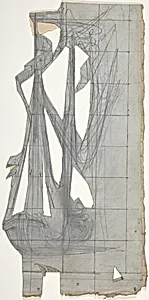
Design for a Stage Set at the Opéra, Paris
1830–90
Medium
Graphite
Dimensions
sheet: 10 13/16 x 5 1/4 in. (27.4 x 13.4 cm)
Classification
Drawings
Department
Drawings and Prints
Museum
Metropolitan Museum of Art, New York, NY
Credit
Gift of Mrs. Henry T. Curtis, 1953
Accession Number
53.668.146
Rights
Public Domain
Tags
Art Historical Context
Eugène Cicéri's *Design for a Stage Set the Opéra, Paris (ca. 1830–90) is a delicate graphite drawing that offers a glimpse into the theatrical magic of 19th-century. Measuring just 10 13/16 x 5 1/4 inches, this compact sheet served as a preparatory sketch for grand stage scenery at the Paris Opéra, the epicenter of Romantic opera and ballet. Cicéri, a master scenic artist, crafted designs that brought composers' visions to life, transforming bare stages into immersive worlds of drama and spectacle. Graphite's subtle tones and precision made it ideal for these functional yet artistic blueprints, allowing designers to convey depth, lighting, and architectural details with remarkable clarity. In an era when theater was a cultural phenomenon—drawing elite audiences to lavish productions like those of Meyerbeer or Wagner—this drawing underscores the behind-the-scenes artistry that elevated performances. Cicéri's work bridged painting and theater, influencing how scenery enhanced emotional narratives. Now in the Metropolitan Museum of Art's Drawings and Prints collection (gift of Mrs. Henry T. Curtis, 1953), it reminds us that every curtain rise began with such inspired sketches, blending technical ingenuity with creative flair.
About the Artist
Eugène Cicéri · 1813–1890
Étienne Eugène Cicéri (1813-1890) was a French painter, lithographer, and theatrical designer who became a notable figure in the Barbizon School movement. Born in Paris on January 27, 1813, into an illustrious artistic family, he was the son of renowned scenographer Pierre-Luc-Charles Cicéri and the nephew of painter Eugène Isabey. Cicéri occupies an important position in 19th-century French land...