
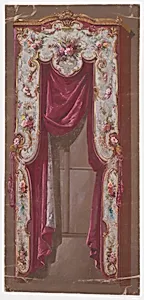
Design for a Valance in with Thin Bushes and Garlands of Flowers and a Shell Motif with a Hanging Curtain
1870–1900 (?)
Medium
Watercolor
Dimensions
Sheet: 15 15/16 × 7 9/16 in. (40.5 × 19.2 cm)
Classification
Drawings|Ornament & Architecture
Department
Drawings and Prints
Museum
Metropolitan Museum of Art, New York, NY
Credit
Elisha Whittelsey Fund, 1949
Accession Number
49.50.189
Rights
Public Domain
Art Historical Context
This delicate watercolor design, created by an anonymous French artist around 1870–1900, served as a blueprint for a valance—the ornate top border of curtains or bed hangings popular in 19th-century interiors. Featuring slender bushes, cascading garlands of flowers, a shell motif, and a curtain, it exemplifies the intricate ornamental patterns that adorned affluent European homes during the Belle Époque era. Such designs reflected the era's fascination with nature-inspired elegance, blending botanical delicacy with classical motifs like shells, evoking seaside whimsy and luxury. Rendered in watercolor on a modest sheet measuring 15 15/16 × 7 9/16 inches, the piece highlights the precision of the medium for architectural and textile ornamentation. Watercolor's transparency allowed artists to layer subtle colors and fine details, making it ideal for pattern books used by manufacturers and decorators. Classified in the Metropolitan Museum of Art's Drawings and Prints department, this work underscores the collaborative craft of design in late 19th-century France, where anonymous talents fueled the decorative arts boom. Acquired through the Elisha Whittelsey Fund in 1949, it offers a glimpse into the unsung artistry behind everyday opulence, reminding us how such patterns transformed ordinary spaces into lavish retreats.
About the Artist
Anonymous, French, 19th century · 1800–1900
**Anonymous, French, 19th Century (ca. 1800–1900)** The artist cataloged as Anonymous, French, 19th century embodies the enigmatic yet essential contributions of unidentified creators to France's vibrant 19th-century art world. Active roughly between 1800 and 1900, this figure—or potentially collective workshop—produced a diverse array of works amid the nation's transition from Neoclassicism thro...