
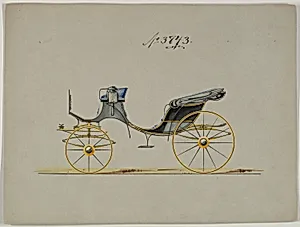
Design for Cabriolet or Victoria, no. 3843
1883
Medium
Pen and black ink, watercolor and gouache with gum arabic
Dimensions
sheet: 6 9/16 x 8 7/8 in. (16.7 x 22.5 cm)
Classification
Drawings
Department
Drawings and Prints
Museum
Metropolitan Museum of Art, New York, NY
Credit
Gift of William Brewster, 1923
Accession Number
23.112.401
Rights
Public Domain
Tags
Art Historical Context
Step into the elegant world of 19th-century luxury transport with *Design for Cabriolet or Victoria, no. 3* by Brewster & Co., a New York carriage maker founded in 1810. Created in 1883, this precise drawing captures a versatile horse-drawn vehicle—either a nimble two-wheeled cabrio with a folding top or a stately four-wheeled Victoria favored by high society. At just 6 9/16 x 8 7/8 inches, it exemplifies the firm's meticulous design process during the Gilded Age, when opulent carriages symbolized wealth and refinement for America's elite. Brewster & Co. crafted bespoke vehicles for figures like the Vanderbilts and Astors, blending functionality with lavish ornamentation. This 1883 design reflects the twilight of the horse-drawn era, just before automobiles reshaped mobility, highlighting carriages as cultural icons of status and craftsmanship. Rendered in pen and black ink for sharp lines, with watercolor, gouache, and gum arabic for vibrant, glossy highlights mimicking polished wood and leather, the medium brings the carriage to life. Now in the Metropolitan Museum of Art's Drawings and Prints department—thanks to a 1923 gift from William Brewster—this work showcases the artistry behind industrial design, inviting us to appreciate a vanished mode of glamour.
About the Artist
Brewster & Co. · 1837–present
**Brewster & Co.** Brewster & Company, a premier American coachbuilder renowned for its exquisite carriage designs, was established in 1810 in New Haven, Connecticut, by James Brewster (1788–1866). Born in 1788, Brewster trained as a wagonmaker's apprentice starting at age 16 in Northampton, Massachusetts, before relocating to New Haven, where he set up his workshop and quickly gained acclaim for...