
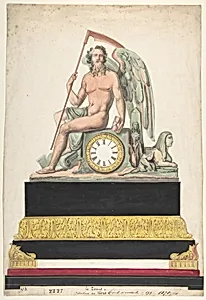
Design for Clock
19th century
Medium
Graphite, pen and black ink, gouache and watercolor
Dimensions
sheet: 14 15/16 x 10 1/4 in. (37.9 x 26.1 cm)
Classification
Drawings
Department
Drawings and Prints
Museum
Metropolitan Museum of Art, New York, NY
Credit
The Elisha Whittelsey Collection, The Elisha Whittelsey Fund, 1962
Accession Number
62.600.280
Rights
Public Domain
Tags
Art Historical Context
This exquisite "Design for Clock" by an anonymous French artist from the 19th century offers a glimpse into the opulent world of decorative arts during France's Belle Époque. Rendered on a sheet measuring nearly 15 by 10 inches, the drawing proposes an elaborate timepiece adorned with a majestic Sphinx—a mythical creature symbolizing wisdom and enigma. Such fantastical motifs were immensely popular in 19th-century France, drawing from Egyptomania sparked by Napoleon's campaigns and the rediscovery of ancient artifacts, blending neoclassical elegance with exotic allure. Crafted in graphite, pen and black ink, gouache, and watercolor, the work showcases the meticulous techniques of atelier designers. These mixed media allowed for precise lines, subtle shading, and vibrant color washes, essential for conveying texture and gleam in proposed luxury objects like clocks. Housed in the Metropolitan Museum of Art's Drawings and Prints department as part of The Elisha Whittelsey Collection, it highlights the preparatory role of such sketches in Parisian workshops, where they bridged imagination and craftsmanship. For visitors, this piece evokes the era's fascination with the mystical East, reminding us how everyday items like clocks became canvases for cultural storytelling. A true gem for admirers of ornamental design!
About the Artist
Anonymous, French, 19th century · 1800–1900
**Anonymous, French, 19th Century (ca. 1800–1900)** The artist cataloged as Anonymous, French, 19th century embodies the enigmatic yet essential contributions of unidentified creators to France's vibrant 19th-century art world. Active roughly between 1800 and 1900, this figure—or potentially collective workshop—produced a diverse array of works amid the nation's transition from Neoclassicism thro...