
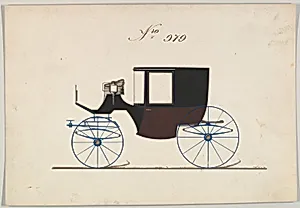
Design for Coupé, no. 979
Medium
Pen and black ink, watercolor and gouache
Dimensions
sheet: 6 1/4 x 9 in. (15.9 x 22.9 cm)
Classification
Drawings
Department
Drawings and Prints
Museum
Metropolitan Museum of Art, New York, NY
Credit
Gift of William Brewster, 1923
Accession Number
23.112.1858
Rights
Public Domain
Tags
Art Historical Context
In the mid-19th century as America's elite flaunted their wealth through opulent modes of transport, Brewster & Co., a premier New York carriage maker, crafted designs like this *Design for Coupé, no. 979*. Attributed to Channing Britton, this delicate drawing from 1850–70 depicts a sleek, enclosed two-passenger coupé—a symbol of refined elegance and status. Horse-drawn carriages were the pinnacle of luxury travel before automobiles, and Brewster's firm supplied vehicles to presidents, royalty, and tycoons, blending craftsmanship with emerging industrial design. Rendered in pen and black ink with watercolor and gouache on a modest 6¼ × 9-inch sheet, the work showcases precise linework for structural details—curved panels, ornate trim, and wheel spokes—enhanced by vibrant washes that evoke polished wood, leather, and metallic accents. Gouache's opaque layering adds depth, mimicking the carriage's glossy finishes. This technical virtuosity highlights how designers communicated complex ideas to artisans, bridging art and engineering. Today, housed in the Metropolitan Museum of Art's Drawings and Prints department (gift of William Brewster, 1923), it offers a window into Gilded Age culture, where such vehicles were rolling status symbols. A charming relic of a bygone era!
About the Artist
Brewster & Co.|Channing Britton · 1837–present
**Brewster & Co.** Brewster & Company, a premier American coachbuilder renowned for its exquisite carriage designs, was established in 1810 in New Haven, Connecticut, by James Brewster (1788–1866). Born in 1788, Brewster trained as a wagonmaker's apprentice starting at age 16 in Northampton, Massachusetts, before relocating to New Haven, where he set up his workshop and quickly gained acclaim for...