
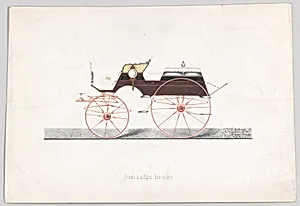
Design for Dos-A-Dos Phaeton Carriage
Medium
Hand colored lithograph with gum arabic and metallic ink and printed image
Dimensions
sheet: 6 3/16 x 9 1/8 in. (15.7 x 23.2 cm)
Classification
Prints
Department
Drawings and Prints
Museum
Metropolitan Museum of Art, New York, NY
Credit
Gift of William Brewster, 1923
Accession Number
23.112.1371
Rights
Public Domain
Tags
Art Historical Context
This hand-colored lithograph from around 1870 presents an elegant design for a dos-à-dos phaeton, a light, open carriage where passengers sit back-to-back. Created by an anonymous French artist working with A. Dick & Co., the print showcases the vehicle’s graceful lines, ornate detailing, and practical features suited for leisurely drives. The compact sheet, measuring just over six by nine inches, was likely intended as a working model or promotional piece for coachbuilders and wealthy clients. In the mid-nineteenth century, such carriages represented both technological refinement and social status, blending English sporting traditions with French taste for refined ornament. The use of lithography allowed designers to circulate detailed, colorful proposals quickly, while the addition of gum arabic and metallic inks lent a luxurious sheen that mimicked the gleam of actual lacquer and brass fittings. Today, the print offers a vivid glimpse into the artistry that once shaped everyday mobility, preserving the elegance of horse-drawn travel on paper long after the carriages themselves have vanished from the streets.
About the Artist
Anonymous, French, 19th century|A. Dick & Co. · 1800–1900
**Anonymous, French, 19th Century (ca. 1800–1900)** The artist cataloged as Anonymous, French, 19th century embodies the enigmatic yet essential contributions of unidentified creators to France's vibrant 19th-century art world. Active roughly between 1800 and 1900, this figure—or potentially collective workshop—produced a diverse array of works amid the nation's transition from Neoclassicism thro...