
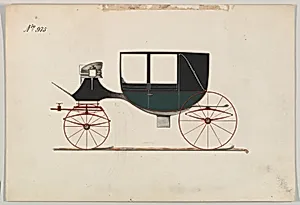
Design for Landau, no. 975
Medium
Pen and black ink, watercolor and gouache with gum arabic and metallic ink
Dimensions
sheet: 6 3/4 x 9 7/8 in. (17.1 x 25.1 cm)
Classification
Drawings
Department
Drawings and Prints
Museum
Metropolitan Museum of Art, New York, NY
Credit
Gift of William Brewster, 1923
Accession Number
23.112.1597
Rights
Public Domain
Tags
Art Historical Context
This delicate design for a Landau carriage, created between 1850 and 1870 by Brewster & Co. with contributions from Channing Britton, captures the elegance of mid-nineteenth-century American coachbuilding. Brewster & Co., one of New York’s premier carriage makers, specialized in luxurious vehicles for the city’s elite. The landau—a four-wheeled open carriage with a folding top—symbolized status and refinement, allowing passengers to enjoy the outdoors while protected from the elements. Such designs were often prepared as presentation pieces to showcase options for ornamentation and structure to prospective clients. Executed in pen and black ink with watercolor, gouache, gum arabic, and metallic ink on a modest sheet measuring roughly 6¾ by 9⅞ inches, the drawing highlights the firm’s attention to both engineering and aesthetics. The shimmering metallic details likely represent brass fittings or decorative accents, while the layered pigments convey the rich upholstery and polished woodwork that defined high-end carriages of the period. These works belong to the Metropolitan Museum’s Department of Drawings and Prints, reflecting how functional objects were elevated through skilled draftsmanship. Gift of William Brewster in 1923, the sheet offers today’s viewers a glimpse into a vanished world of bespoke transportation, where art and industry converged to create mobile symbols of prosperity.
About the Artist
Brewster & Co.|Channing Britton · 1837–present
**Brewster & Co.** Brewster & Company, a premier American coachbuilder renowned for its exquisite carriage designs, was established in 1810 in New Haven, Connecticut, by James Brewster (1788–1866). Born in 1788, Brewster trained as a wagonmaker's apprentice starting at age 16 in Northampton, Massachusetts, before relocating to New Haven, where he set up his workshop and quickly gained acclaim for...