
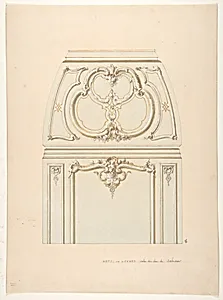
Design for Rococco-style wall and cove ornament in the salon of the Hotel de Luynes, owned by the Duc de Sabran
second half 19th century
Medium
pen and ink and watercolor on wove paper
Dimensions
Overall: 14 5/16 x 10 1/2 in. (36.4 x 26.7 cm)
Classification
Drawings
Department
Drawings and Prints
Museum
Metropolitan Museum of Art, New York, NY
Credit
Dodge Fund, 1967
Accession Number
67.827.143
Rights
Public Domain
Tags
Art Historical Context
This exquisite drawing captures a Rococo-style design for the wall and cove ornamentation in the salon of the de Luynes, a Parisian private mansion owned by the Duc Sabran. Created in the second half of 19th century by Jules-Edmond- Lachaise and Eug-Pierre Gourdet, it the era's fascination with historicism and revival styles. Rococo, originally an 18th-century French movement celebrated for its playful asymmetry, scrolling motifs, and lavish embellishments, experienced a resurgence during the Second Empire and Belle Époque, adorning the opulent interiors of the aristocracy. Rendered in pen and ink with watercolor on wove paper (14 5/16 x 10 1/2 in.), the work showcases meticulous drafting techniques typical of architectural drawings. Fine ink lines define intricate shell-like curves, foliage, and floral garlands, while soft watercolors add depth and luminosity, evoking the shimmering elegance of gilded salons. Such preparatory sketches were essential for commissioning decorators, bridging imagination and execution in high-society renovations. Housed in The Metropolitan Museum of Art's Drawings and Prints department (acquired via the Dodge Fund in 1967), this piece offers a window into 19th-century French luxury and the enduring allure of Rococo revival, blending nostalgia with neoclassical refinement.
About the Artist
Jules-Edmond-Charles Lachaise|Eugène-Pierre Gourdet|Duc de Sabran · 1897–1897
Jules-Edmond-Charles Lachaise, born Jules Lachaise on September 2, 1836, in Paris, emerged as a prominent French painter and draughtsman specializing in lavish interior decorations during the Second Empire and beyond. Little is known about his early life and formal training, though he married Berthe Gourdet in 1866, forging a close professional partnership with her brother, the decorator Eugène-Pi...