
Design for the Right Side of a Door with Pediment and Fluted Pilasters
17th century
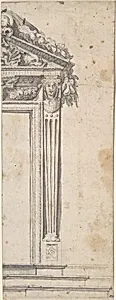
Medium
Point of brush and gray ink, brush and gray wash, over graphite underdrawing and ruled construction
Dimensions
sheet: 8 3/4 x 3 3/8 in. (22.2 x 8.5 cm)
Classification
Drawings|Ornament & Architecture
Department
Drawings and Prints
Museum
Metropolitan Museum of Art, New York, NY
Credit
The Elisha Whittelsey Collection, The Elisha Whittelsey Fund, 1952
Accession Number
52.570.131
Rights
Public Domain
Tags
Art Historical Context
This delicate 17th-century Italian drawing, created by an anonymous artist, presents a precise design for the right side of a door featuring a classical pediment and fluted pilasters. Measuring just 8 3/4 x 3 3/8 inches, it exemplifies the meticulous preparatory sketches used by architects and designers during Italy's Baroque era, when opulent palaces and churches demanded intricate ornamental details. Housed in the Metropolitan Museum of Art's Elisha Whittelsey Collection, it highlights the era's fascination with symmetry and grandeur, drawing from ancient Roman motifs to elevate everyday architecture. Executed in point of brush and gray ink with brush and gray wash over graphite underdrawing and ruled construction lines, the work showcases advanced drafting techniques. The graphite outlines and straightedge rulings ensure architectural accuracy, while subtle washes add depth and shadow, simulating how the carved stone elements would catch light. These methods were essential for communicating complex ideas to sculptors and builders before construction. As a rare surviving example of anonymous ornamental draftsmanship, this sheet offers a window into the collaborative workshops of 17th-century Italy, where such designs adorned the doorways of noble homes and sacred spaces, blending functionality with artistic splendor.