
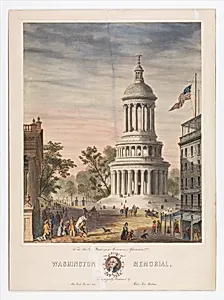
Design for the Washington Memorial, New York
1844
Medium
Hand-colored lithograph
Dimensions
Image: 20 5/16 × 16 5/8 in. (51.6 × 42.3 cm) Sheet: 25 3/16 × 18 11/16 in. (64 × 47.4 cm)
Classification
Prints
Department
Drawings and Prints
Museum
Metropolitan Museum of Art, New York, NY
Credit
The Edward W. C. Arnold Collection of New York Prints, Maps and Pictures, Bequest of Edward W. C. Arnold, 1954
Accession Number
54.90.1454
Rights
Public Domain
Tags
Art Historical Context
In 1844, Scottish-born architect Robert Kerr proposed this striking design for a Washington Memorial in New York City captured in a hand-colored lithograph that vividly brings the vision to life. Measuring over 20 inches across, the print depicts a grand monumental structure adorned with flags, evoking patriotism and reverence for George Washington at a time when the young United States was eager to honor its founding father through public architecture. Such proposals proliferated in the mid-19th century, a growing national identity and civic pride amid urban expansion. Lithography, a revolutionary printing technique of the era, allowed for detailed reproductions of architectural plans, while the hand-applied colors—likely washes of watercolor or gouache—enhance the dramatic effect, making the monument appear both majestic and tangible. Kerr's design, with its emphasis on flags and imposing form, underscores the era's neoclassical influences, blending symmetry and symbolism to inspire public support. Today, this print from The Metropolitan Museum of Art's Edward W. C. Arnold Collection offers a window into unbuilt dreams of American monumentalism, reminding us how art and architecture intersected to shape cultural memory. Visitors can appreciate its technical finesse and historical what-if allure.