
Design for Upright Decorative Panels
18th century
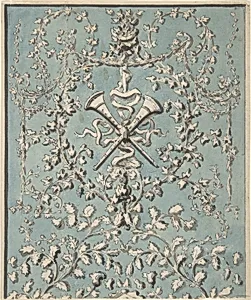
Medium
Pen and gray ink, brush and gray wash with background in brush and blue wash. Cut at the bottom
Dimensions
7 5/16 x 6 3/16 in. (18.6 x 15.7 cm)
Classification
Drawings
Department
Drawings and Prints
Museum
Metropolitan Museum of Art, New York, NY
Credit
Funds from various donors, 1969
Accession Number
69.658.2
Rights
Public Domain
Tags
Art Historical Context
This delicate 18th-century French, titled *Design for Upright Decor Panels*, exemplifies the ornate decorative arts of the Rococo era. Created anonymously by a skilled draftsman, it served as a preparatory blueprint for elegant wall panels or furniture decorations, common in lavish French interiors like those of Versailles or aristocratic salons. The upright format and intricate motifs—featuring musical instruments intertwined with blooming flowers and scrolling leaves—evoke the period's love for playful, asymmetrical elegance, celebrating music, nature, and leisure. Rendered in pen and gray ink with subtle brush and gray wash for shading, the design gains depth from a soft blue wash background, mimicking textile or painted boiseries. Notably cut at the bottom, it hints at its working nature, perhaps trimmed for presentation or use. This mixed-media technique allowed artists to convey texture and light efficiently, guiding engravers, woodcarvers, or gilders in crafting opulent furnishings. Housed in the Metropolitan Museum of Art's Drawings and Prints department, this piece offers a window into 18th-century design workshops, where such patterns fueled the decorative revolution, blending whimsy with sophistication for everyday luxury.
About the Artist
Anonymous, French, 18th century · 1700–1800
The artist known as Anonymous, French, 18th century, represents a collective of unidentified talents active roughly between 1700 and 1800, a period of profound artistic evolution in France from the opulent Rococo to the austere dawn of Neoclassicism and Revolutionary fervor. Little is documented about their personal training or mentors, as their anonymity obscures individual biographies, though th...