
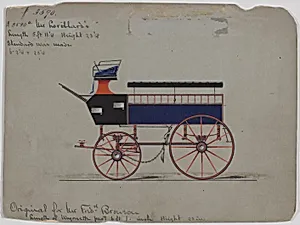
Design for Wagonette Break, no. 3590
1880
Medium
Pen and black ink, watercolor and gouache with gum arabic
Dimensions
sheet: 6 7/8 x 9 3/4 in. (17.5 x 24.8 cm)
Classification
Drawings
Department
Drawings and Prints
Museum
Metropolitan Museum of Art, New York, NY
Credit
Gift of William Brewster, 1923
Accession Number
23.112.461
Rights
Public Domain
Tags
Art Historical Context
Step into the elegant world of 19th-century coachmaking with *Design for Wagonette Break no. 3590*, a meticulously rendered drawing by the renowned New York firm Brewster & Co., dated 1880. Brewster & Co., founded in 1810, was America's premier carriage maker, crafting bespoke vehicles for the elite—including tycoons like the Vanderbilts and Astors. This design showcases a "wagonette break," a, open four-wheeled ideal for leisurely drives, blending functionality with opulent detailing. At the height of the horse-drawn era, just before automobiles reshaped transportation, such designs symbolized status and craftsmanship. Executed in pen and black ink with watercolor, gouache, and gum arabic on a modest 6 7/8 x 9 3/4-inch sheet, the work exemplifies precision drafting techniques. The fine ink lines define the carriage's graceful curves and ornate features, while opaque gouache and glossy gum arabic add vibrant color and luster, mimicking the polished wood, brass fittings, and leather upholstery of the final product. These mixed media were standard in industrial design, allowing makers to visualize and refine luxury vehicles with lifelike realism. Housed in the Metropolitan Museum of Art's Drawings and Prints department—thanks to a 1923 gift from William Brewster—this piece highlights the artistry behind everyday opulence. It offers a window into Gilded Age innovation, where carriages were rolling statements of wealth and ingenuity, preserved as a testament to a vanishing equestrian culture.
About the Artist
Brewster & Co. · 1837–present
**Brewster & Co.** Brewster & Company, a premier American coachbuilder renowned for its exquisite carriage designs, was established in 1810 in New Haven, Connecticut, by James Brewster (1788–1866). Born in 1788, Brewster trained as a wagonmaker's apprentice starting at age 16 in Northampton, Massachusetts, before relocating to New Haven, where he set up his workshop and quickly gained acclaim for...