
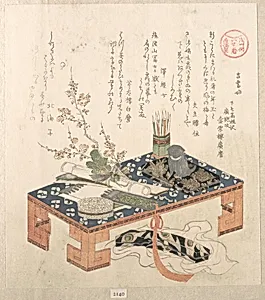
『浅草側いせ暦』 文房具と梅熨斗『春雨集』 摺物帖 |“Desk with Writing Set and Plum Flowers,” from the series Ise Calendars for the Asakusa Group (Asakusa-gawa Ise goyomi)From the Spring Rain Collection (Harusame shū), vol. 2
probably 1814 (Year of the Dog)
Medium
Woodblock print (surimono); ink and color on paper
Dimensions
8 1/4 x 7 3/8 in. (21 x 18.7 cm)
Classification
Prints
Culture & Period
Japan · Edo period (1615–1868)
Department
Asian Art
Museum
Metropolitan Museum of Art, New York, NY
Credit
H. O. Havemeyer Collection, Bequest of Mrs. H. O. Havemeyer, 1929
Accession Number
JP2140
Rights
Public Domain
Tags
Art Historical Context
Kubo Shunman (1777–1845), a versatile ukiyo-e artist Japan's Edo period, crafted this exquisite woodblock print around 1814 as part of the *Asakusa-gawa Ise goyomi* series from the *Harusame shū* (Spring Rain Collection), volume 2. Titled *“Desk with Writing Set and Plum Flowers,”* it exemplifies *surimono*—privately commissioned prints often exchanged as New Year's greetings among poetry circles. These luxurious, small-format works (just 8¼ x 7⅜ inches) featured hidden calendars in the Ise style, blending art with practical utility for elite patrons like the Asakusa poetry group. The composition centers on a scholar's desk adorned with writing brushes, inkstone, and delicate plum blossoms—symbols of literary refinement and the arrival of spring. Playful animals peek amid the still life, adding whimsy typical of Shunman's playful yet precise style. Printed with vibrant inks and subtle colors on fine paper, the technique highlights *surimono*'s hallmarks: crisp lines, metallic accents (like mica for shimmer), and embossing for texture, making each print a tactile treasure. In Edo-era Japan, such works celebrated *renga* poetry gatherings and the literati culture of urban Tokyo (then Edo). Today, at the Metropolitan Museum of Art, this piece from the H.O. Havemeyer Collection invites us to savor the fusion of beauty, wit, and seasonal poetry in miniature form.
About the Artist
Kubo Shunman · 1757–1820
Japanese, 1757–1820