
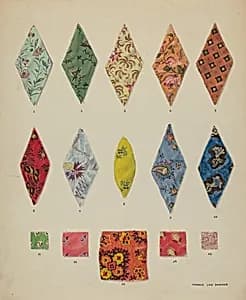
Detail of Quilt
c. 1937
Medium
watercolor, gouache, and graphite on paperboard
Dimensions
overall: 35.8 x 28.8 cm (14 1/8 x 11 5/16 in.) Original IAD Object: 128 1/2" square
Classification
Index of American Design
Department
CG-W
Museum
National Gallery of Art, Washington, D.C.
Credit
Index of American Design
Accession Number
1943.8.827
Rights
Public Domain
Art Historical Context
This exquisite *Detail of Quilt* by Francis Law Durand, created around 1937, captures the intricate patterns and vibrant textures of an American folk quilt measuring a full 128½ inches square. Rendered in watercolor, gouache, and graphite on paperboard (35.8 × 28.8 cm), it belongs to the Index of American Design, a landmark WPA Federal Art Project from the Great Depression era. This initiative employed artists to document everyday American crafts, preserving cultural heritage through precise, colorful renderings. Durand's meticulous technique highlights the quilt's pieced construction—a hallmark of 19th- and early 20th-century American textile traditions. Watercolor and gouache lend luminous depth to fabrics, while graphite outlines sharp edges, evoking the tactile quality of thread and cloth. Quilts like this symbolized resourcefulness, community gatherings (often called "quilting bees"), and women's artistic expression, blending utility with storytelling motifs. As part of the National Gallery of Art's collection, this work celebrates the unassuming beauty of vernacular design, reminding us how ordinary objects embody a nation's creative spirit. A testament to both endurance and artistry, it invites viewers to appreciate the hidden mastery in America's handmade legacy.
About the Artist
Francis Law Durand
**Francis Law Durand (1906–1995)** Born on March 31, 1906, in Mount Holly, New Jersey, Francis Law Durand emerged as a skilled American draftsman and artist during the Great Depression era. Little is known about his early life or formal training, as biographical details remain sparsely documented beyond his professional output. By 1935, he was employed by the Works Progress Administration (WPA), ...