
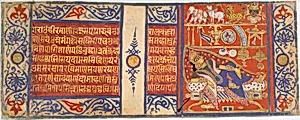
Devananda's Fourteen Auspicious Dreams Foretelling the Birth of Mahavira: Folio from a Kalpasutra Manuscript
ca. 1465
Medium
Opaque watercolor on paper
Dimensions
Overall: 4 5/8 x 11 1/2 in. (11.8 x 29.2 cm)
Classification
Paintings
Culture
India, (Gujarat, Jaunpur)
Department
Asian Art
Museum
Metropolitan Museum of Art, New York, NY
Credit
Purchase, Cynthia Hazen Polsky Gift, 1992
Accession Number
1992.359
Rights
Public Domain
Tags
Art Historical Context
This delicate folio from a Kalpasutra manuscript captures pivotal moment in Jain sacred narrative: Queen Devananda’s fourteen auspicious dreams, which herald the birth of Mahavira, the twenty-fourth Tirthankara. Created around 1465 in Jaunpur, in northern India, the painting belongs to a lavishly illustrated version of the Kalpasutra, a foundational Jain text that recounts the lives of the Tirthankaras and guides monastic conduct. Such manuscripts were commissioned by wealthy Jain merchants and lay communities to earn spiritual merit and to be ritually read during the Paryushana festival. The work is attributed to the Master of the Jaunpur Kalpasutra, whose distinctive style blends vibrant opaque watercolor with precise line work and a lively sense of pattern. Although the horizontal format is modest—roughly four and a half by eleven inches—the composition elegantly accommodates symbolic vignettes featuring women and elephants, two of the auspicious dream emblems. These details reflect the refined aesthetic of fifteenth-century Gujarati-Jain painting, where rich mineral pigments and gold accents transform doctrinal stories into visually compelling objects of devotion and contemplation.