
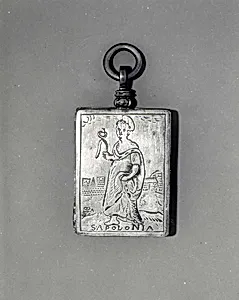
Devotional diptych pendant
Unknown Artist
2nd half 16th century
Medium
SIlver, boxwood, humingbird feathers, and glass
Dimensions
H. 5 cm, w. 2.5 cm, d. 6 cm
Classification
Jewelry, Precious Metals and Precious Stones
Culture
Mexican
Department
Robert Lehman Collection
Museum
Metropolitan Museum of Art, New York, NY
Credit
Robert Lehman Collection, 1975
Accession Number
1975.1.1535
Rights
Public Domain
Tags
Art Historical Context
This exquisite devotional diptych pendant, crafted in Mexico during the second half of the 16th century, exemplifies the vibrant fusion of Indigenous and European artistry in colonial New Spain. Measuring just 5 cm high, 2.5 cm wide, and 6 cm deep, this tiny silver-framed jewel opens like a miniature book to reveal intricately carved boxwood panels adorned with iridescent hummingbird feathers and glass inlays. Likely depicting Saint George and other saints, it served as a personal talisman for Catholic devotion, worn close to the heart by the faithful. The use of hummingbird feathers highlights a masterful Indigenous technique known as *mosaico de plumas*, prized in pre-Hispanic Mexico for its shimmering, jewel-like quality symbolizing divinity and the sacred. Paired with European silverwork and Christian iconography, the pendant reflects the cultural syncretism of the early colonial era, when Aztec featherworkers adapted their skills to produce luxurious religious objects for Spanish clergy and elites. Housed in the Metropolitan Museum of Art's Robert Lehman Collection since 1975, it offers a window into the spiritual and artistic exchanges that shaped Mexico's colonial heritage.