
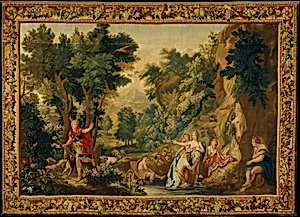
Diana and Actaeon from a set of Ovid's Metamorphoses
designed before 1680, woven late 17th–early 18th century
Medium
Wool, silk (20 warps per inch, 8 per cm.)
Dimensions
10 ft. 10 in. × 15 ft. 2 in. (330.2 × 462.3 cm)
Classification
Textiles-Tapestries
Culture
French, Paris
Department
European Sculpture and Decorative Arts
Museum
Metropolitan Museum of Art, New York, NY
Credit
Gift of Mrs. George S. Amory, in memory of her father and mother, Mr. and Mrs. Amory Sibley Carhart, 1964
Accession Number
64.208
Rights
Public Domain
Tags
Art Historical Context
This magnificent tapestry, *Diana and Actaeon from a set illustrating Ovid's *Metamorphoses*, captures a dramatic moment from classical mythology: the hunter Actaeon accidentally spies the goddess Diana and her nymphs bathing, leading to his transformation into a stag and demise by his own hounds. Designed before 1680 by Jean the Younger and woven at the prestigious Manufacture Nationale des Gobel in Paris during the late 17th early 18th century it exemplifies the opulent Baroque style favored by French royalty. Produced at Louis XIV's royal workshop, Gobelins tapestries were symbols of power and luxury, adorning palaces like Versailles. Woven from wool and silk with an impressive 20 warps per inch (8 per cm), this vast piece—measuring over 10 by 15 feet—showcases extraordinary technical mastery. The fine weave allows for intricate details in the nymphs' flowing drapery, the dogs' dynamic energy, and the lush landscape, blending vivid color with narrative depth. A gift to the Metropolitan Museum of Art in 1964, this French masterpiece highlights the cultural prestige of tapestry art, where myth served as both decoration and moral tale, transporting viewers to an ancient world of divine retribution and natural beauty.