
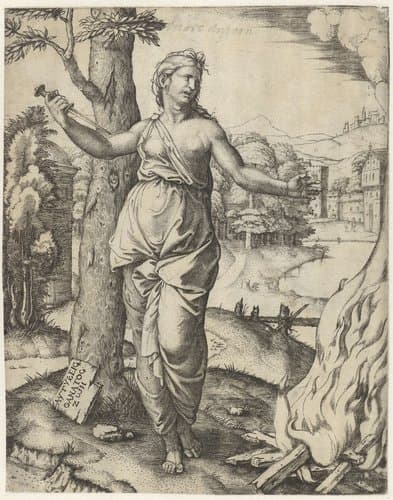
Dido doodt zichzelf met dolk naast brandstapel
1508 - 1512
Medium
engraving
Dimensions
125; 159
Rights
Public Domain
About this artwork
De figuur van de heilige lijkt stilistisch op de fresco's in de Stanza della Segnatura van Raphael te Rome. De tweede staat is herkenbaar aan de griekse tekst op het bordje aan de voet van de boom.
Art Historical Context
Behold *Dido Doodt Zichzelf met Dolk Naast Brandst* (Dido Kills Herself with a Dagger Beside Funeral Pyre), a poignant engraving by Marcantonioondi, created between 1508 and 1512. This intimate work, measuring just 159 × 125 mm, captures tragic climax from Virgil's *Aeneid*: Queen Dido of Carthage, abandoned by Aeneas, takes her life on a blazing pyre. Raimondi's mastery of the burin brings dramatic tension to the scene, with intricate lines conveying Dido's anguish and the flickering flames. Raimondi, a pioneering Italian engraver of the High Renaissance, was renowned for reproducing designs by Raphael, whose influence shines here. A central figure echoes the graceful, idealized forms of Raphael's frescoes in the Vatican’s Stanza della Segnatura—like the *School of Athens*—blending classical mythology with sacred stylistic poise. This connection underscores engraving's role in disseminating Raphael's innovations across Europe, making elite art accessible to collectors and scholars. Printed in multiple states, the second is identifiable by Greek text on a plaque at the tree's base, a detail print enthusiasts prize for its rarity. As a technical marvel, Raimondi's engraving not only immortalizes a literary icon but also advanced the medium, bridging antiquity and Renaissance humanism for generations of admirers.
About the Artist
Marcantonio Raimondi · 1475–1534
Marcantonio Raimondi (c. 1480–1534), born near Bologna, Italy, emerged as one of the Renaissance's premier engravers, revolutionizing printmaking through his mastery of reproductive techniques. He trained in the workshop of the goldsmith, painter, and niellist Francesco Francia, whose influence is evident in his early engravings, such as the goldsmith-like shading in *Pyramus and Thisbe* (1505), h...