
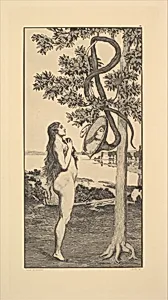
Die Schlange from Eva und die Zukunft (Rad.-Werk III)
Medium
Etching; ninth state of nine
Dimensions
Plate: 11 9/16 x 6 1/8 in. (29.4 x 15.5 cm) Sheet: 23 5/8 x 17 5/16 in. (60 x 44 cm)
Classification
Prints
Department
Drawings and Prints
Museum
Metropolitan Museum of Art, New York, NY
Credit
Purchase, Gift of A. G. Raskin, 1963
Accession Number
63.572.1(4)
Rights
Public Domain
Tags
Art Historical Context
Max Klinger's "Die Schlange" (The Serpent), created in 1898, forms part of his evocative series "Eva und die Zukunft" (Eve and the Future). This ninth and final state of the etching reveals the German artist's careful refinement of line and tone. Printed by Wilhelm Felsing and acquired by the Metropolitan Museum of Art in 1963, the work measures just under 12 by 6 inches in the plate yet conveys expansive symbolic weight through its intimate scale. Klinger, a leading figure in the Symbolist movement, frequently explored themes of mythology, psychology, and human fate. Here, the serpent, Eve, and mirrors intertwine to suggest temptation, self-reflection, and the uncertain path ahead. Etching's capacity for delicate detail and dramatic contrast allowed him to merge biblical narrative with dreamlike ambiguity, inviting viewers to consider destiny beyond the Garden of Eden. As the third installment in Klinger's print cycles, the series demonstrates his innovative approach to sequential imagery. It bridges 19th-century Romanticism and emerging modernist sensibilities, encouraging contemplation of timeless questions about choice and consequence.
About the Artist
Max Klinger|Max Klinger|Wilhelm Felsing · 1857–1920
Max Klinger, born on February 18, 1857, in Leipzig to a wealthy family, emerged as one of Germany's most innovative artists across painting, sculpture, printmaking, and graphics. Demonstrating early talent, he enrolled at the Academy of Fine Arts in Karlsruhe in 1874 as a pupil of Karl Gussow, following his teacher to the Berlin Academy upon Gussow's appointment as director, and graduated in 1877 ...