
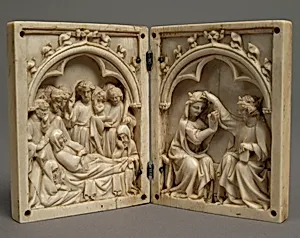
Diptych with the Death and Coronation of the Virgin
Unknown Artist
ca. 1330–50
Medium
Ivory with metal mounts
Dimensions
Overall (opened): 2 11/16 x 4 3/16 x 1/4 in. (6.9 x 10.7 x 0.7 cm) Overall: 2 11/16 x 2 3/16 x 11/16 in. (6.9 x 5.5 x 1.8 cm) wing: 2 11/16 x 2 3/16 x 1/4 in. (6.9 x 5.5 x 0.7 cm)
Classification
Ivories
Culture
French
Department
Medieval Art
Museum
Metropolitan Museum of Art, New York, NY
Credit
Rogers Fund, 1910
Accession Number
10.134.7
Rights
Public Domain
Tags
Art Historical Context
This delicate French ivory diptych created around 1330–50, captures two pivotal moments in the life of the Virgin Mary: Death (or Dormition) on one panel and her Coronation in heaven on the other. Measuring just under 3 inches tall when open, its diminutive size and hinged metal mounts made it a perfect portable devotional object for medieval nobility or clergy, easily carried in a pocket or worn on a belt for private prayer. Crafted during the Gothic era, when intricate ivory carving flourished in Parisian workshops, the unknown artist employed fine chiseling techniques to render expressive figures—men and women gathered at Mary's bedside, angels, and Christ crowning her as Queen of Heaven. Elephant ivory's smooth, luminous quality allowed for lifelike drapery folds and emotional gestures, embodying the period's emphasis on spiritual intimacy and Marian devotion, central to Catholic piety. Today, housed in the Metropolitan Museum of Art's Medieval Art collection (Rogers Fund, 1910), this diptych exemplifies the technical mastery and cultural reverence for the Virgin in 14th-century France, offering a window into the era's blend of artistry and faith.