
Dish covers, coolers, soup tureens, salt cellars, pepper and mustard pots, sauceboats
c. 1819
Medium
gild
Dimensions
3530; 29.6; 16.2; 34.3
Rights
Public Domain
About this artwork
alloy mark
Art Historical Context
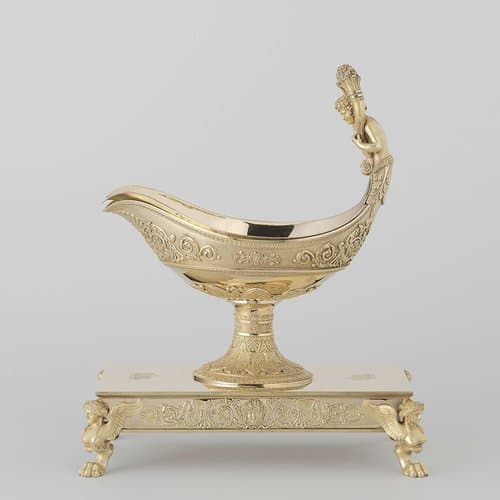
Jean-Baptiste-Claude Odiot, a renowned French silversmith and bronzier, crafted this exquisite ensemble of tableware around 1819. The set includes dish covers, coolers, tureens, salt cell, pepper and mustard pots and sauceboats, all in gilded metal—likely a luxurious alloy finished with a gleaming gold surface, as indicated by the alloy. Measuring approximately 34.3 cm high, 29.6 cm wide, and 16.2 cm deep, with a substantial weight of about 3,530 grams, these pieces exemplify the opulence of early 19th-century French decorative arts. Created during the Bourbon Restoration under Louis XVIII, following Napoleon's defeat, Odiot's work bridges the grandeur of the Empire style with neoclassical elegance. Having supplied Napoleon with imperial regalia, Odiot adapted his mastery of chasing, engraving, and gilding for the tastes of restored royalty and aristocracy. Gilding, achieved through electroplating or mercury gilding techniques, not only enhanced durability against tarnish but also symbolized wealth and refinement at grand banquets. These functional yet sculptural objects highlight the era's fusion of utility and artistry, where dining became a theater of status. Visitors can appreciate how Odiot's precise craftsmanship elevated everyday silver service into heirloom treasures, reflecting France's resilient cultural prestige post-Revolution.