
Dish covers, coolers, soup tureens, salt cellars, pepper and mustard pots, sauceboats
c. 1819
Medium
gild
Dimensions
12.2; 1900; 19.2; 32.2
Rights
Public Domain
About this artwork
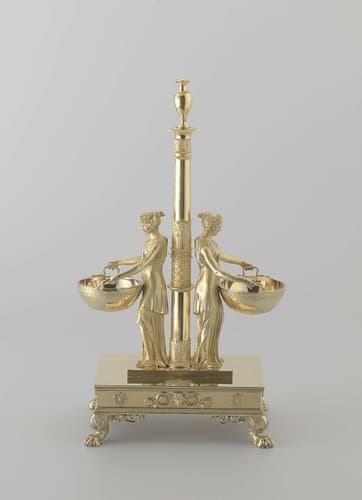
Empire dubbel zoutvat, van verguld zilver. Op een rechthoekige basis, staan 2 vrouwen in antieke klederdracht ruggelings naar een zuil gekeerd. Zij dragen ieder een rond vat met binnenbakje. Gegraveerd met het wapen van Potemkin.
Art Historical Context
Crafted around 1819 by the renowned French goldsmith Jean-Claude Odiot, exquisite double salt cellar exemplifies the opulent Empire style, a neoclassical aesthetic favored during the Napoleonic era. Odiot, a master silversmith who supplied royalty and emperors, blended ancient Roman grandeur with refined French craftsmanship. Made of gilded silver—a technique that applies a thin layer of gold over silver for luxurious shine and corrosion resistance—this piece reflects the era's taste for grandeur in tableware, elevating everyday dining to imperial splendor. Perched on a rectangular base, two graceful women in antique drapery stand back-to-back, facing a central column, each cradling a round salt vat with an inner liner. Their poised figures evoke classical mythology, symbolizing abundance and hospitality. Finely engraved with the coat of arms of Grigory Potemkin, the influential 18th-century Russian prince and Catherine the Great's favorite, it hints at elite patronage, perhaps linking to his descendants or admirers long after his 1791 death. Measuring 32.2 cm high and weighing nearly 1.9 kg, this salt cellar was part of lavish silver services including tureens, pots, and sauceboats. It showcases Odiot's skill in figural sculpture and chasing, bridging art and functionality for Europe's aristocracy. A testament to Empire elegance, it invites us to savor history's glittering feasts.