
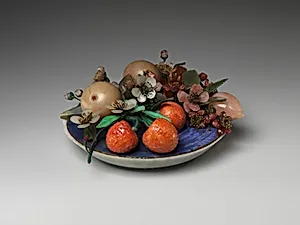
Dish of Fruit and Peach Blossoms
Unknown Artist
18th–19th century
Medium
Jade (jadeite) and various stones, amber, glass, bone, and feathers
Dimensions
H. 3 1/8 in. (7.9 cm); Diam. 7 in. (17.8 cm)
Classification
Jade
Culture & Period
China · Qing dynasty (1644–1911)
Department
Asian Art
Museum
Metropolitan Museum of Art, New York, NY
Credit
Gift of Heber R. Bishop, 1902
Accession Number
02.18.746
Rights
Public Domain
Tags
Art Historical Context
This exquisite *Dish of Fruit and Peachossoms*, crafted by an unknown artist during China's Qing dynasty (16441911), showcases the era's mastery of jade carving. Made primarily from vibrant jadeite—prized for its luminous green hues and translucency—the dish (7 inches in diameter) is adorned with an array of realistic fruits and blooming peach branches. Intricate inlays of amber, glass, bone,, and other stones bring the motifs to life, mimicking textures from velvety peach skin to delicate petals. In Qing imperial workshops, jade objects like this blended utility and artistry, often serving as scholarly tableware or gifts symbolizing prosperity. Peaches held profound cultural meaning in China, representing longevity and immortality, while the blossoms evoked spring renewal and abundance. The multi-material technique highlights innovative 18th–19th-century methods, where carvers polished jade to a glassy sheen and embedded contrasting elements for hyper-realistic depth. A gift to the Metropolitan Museum of Art from Heber R. Bishop in 1902, this piece invites visitors to appreciate the Qing artisans' patience and skill, turning a simple dish into a timeless emblem of nature's bounty.