
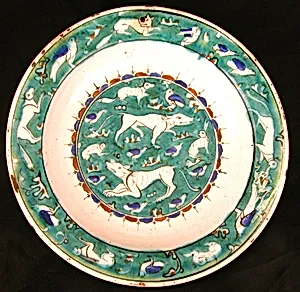
Dish with Bird, Rabbit, and Quadruped Design
Unknown Artist
last quarter 16th century
Medium
Stonepaste; polychrome painted under transparent glaze
Dimensions
H. 2 3/16 in. (5.6 cm) Diam. of rim: 11 1/4 in. (28.6 cm)
Classification
Ceramics
Department
Islamic Art
Museum
Metropolitan Museum of Art, New York, NY
Credit
Purchase, Richard S. Perkins Gift and Louis E. and Theresa S. Seley Purchase Fund for Islamic Art, 1979
Accession Number
1979.412
Rights
Public Domain
Tags
Art Historical Context
This exquisite dish, titled *Dish Bird, Rabbit, and Quadruped Design hails from the last quarter of the16th century and exemplifies vibrant ceramic traditions of Islamic art. Crafted as a shallow serving vessel with a height of just over 2 inches and a rim diameter of 11 inches, it features lively depictions of a bird, rabbit, and unidentified quadruped, rendered in a playful, dynamic composition. These animal motifs, common in Islamic decorative arts, evoke the natural world while adhering to aniconic conventions through stylized, non-narrative forms. Made from stonepaste—a composite body of quartz, clay, and frit prized for its fine white surface and durability—the dish showcases polychrome painting under a transparent glaze. This technique, perfected in the Islamic world from the medieval period onward, allowed bold colors to shine through the glossy overglaze, creating depth and luminosity that mimicked costly Chinese porcelain. Such wares were produced in centers like Iznik in the Ottoman Empire or Tabriz in Safavid Iran, serving both practical dining needs and aesthetic display in elite households. Today, housed in the Metropolitan Museum of Art's Islamic Art Department (acquired in 1979), this piece highlights the ingenuity of anonymous artisans who blended functionality with artistry. Its whimsical animal parade invites visitors to ponder the cultural delight in nature's creatures, bridging everyday life and artistic splendor across centuries.