
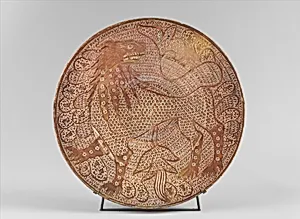
Dish with Lion
Unknown Artist
ca. 1500
Medium
Tin-glazed earthenware
Dimensions
Overall: 18 5/8 x 2 13/16 in., 6.111lb. (47.3 x 7.1 cm, 2772g)
Classification
Ceramics
Culture
Spanish
Department
The Cloisters
Museum
Metropolitan Museum of Art, New York, NY
Credit
The Cloisters Collection, 1956
Accession Number
56.171.155
Rights
Public Domain
Tags
Art Historical Context
This stunning *Dish with Lion*, crafted around 1500 in Spain, exemplifies the vibrant tin-glazed earthenware known as Hispano-Moresque pottery. Measuring nearly 19 inches across, this shallow dish features a bold central lion motif, rendered in rich cobalt blue and golden luster against a starry turquoise ground—a technique borrowed from Islamic artisans and perfected in workshops like those in Manises and Valencia The tin glaze created a smooth, impermeable surface ideal for both decorative display and practical use, allowing vivid colors that wouldn't fade with washing. Produced during Spain's late Gothic to early Renaissance transition, amid the cultural fusion of Christian, Jewish, and Muslim influences post-Reconquista, such dishes were prized luxury items for elite tables. The lion, a symbol of strength, nobility, and even Spanish heraldry, underscores the era's fascination with powerful beasts, evoking chivalric tales and royal iconography. These wares were exported across Europe, bridging medieval and Renaissance aesthetics. Housed in The Cloisters Collection at The Metropolitan Museum of Art since 1956, this piece invites visitors to appreciate how everyday objects became canvases for artistic innovation, reflecting Spain's rich ceramic heritage.