
Disk Brooch
Unknown Artist
late 5th–early 6th century
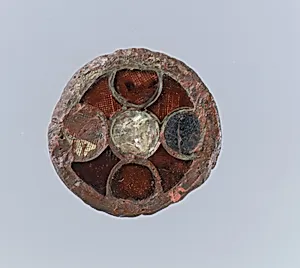
Medium
Copper alloy, garnets and green glass with patterned foil backings, mother-of-pearl; iron back
Dimensions
Overall: 7/8 x 3/16 in. (2.3 x 0.4 cm)
Classification
Metalwork-Copper alloy
Culture
Frankish
Department
Medieval Art
Museum
Metropolitan Museum of Art, New York, NY
Credit
Gift of J. Pierpont Morgan, 1917
Accession Number
17.191.13
Rights
Public Domain
Art Historical Context
This exquisite Disk Brooch, crafted by an unknown Frankish artisan in the late 5th to early 6th century exemplifies the opulent metalwork of the Merovingian period. Measuring just 7/8 x 3/16 inches, this tiny copper alloy treasure was likely used to fasten cloaks or garments, serving as a badge of status among early medieval elites in what is now France and surrounding regions. Housed in the Metropolitan Museum of Art's Medieval department, it entered the collection as a gift from J Pierpont Morgan in 7. The brooch's surface dazzles with cloisonné technique, where garnets and green glass are set into delicate cells backed by patterned gold foil to enhance their sparkle through light refraction. Delicate mother-of-pearl inlays add a pearlescent glow, while the iron back provided durability. These materials—sourced from distant trade networks—highlight the Franks' mastery in blending Roman jewelry traditions with innovative gem-cutting and foilwork, creating a luminous effect that mimicked imperial luxury. As a cultural artifact, the brooch reflects the Frankish world's transition from late antiquity to the Middle Ages, where personal adornments symbolized power and piety. Its intricate design invites us to imagine a warrior or noblewoman wearing it, bridging the gap between everyday life and high artistry in a formative era of European history.