
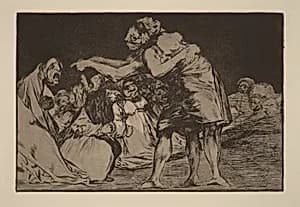
Disparate desordenado (Disorderly Folly)
in or after 1816
Medium
etching, aquatint and drypoint
Classification
Department
CG-E
Museum
National Gallery of Art, Washington, D.C.
Credit
Gift of Mrs. Jane C. Carey in memory of her mother, Mrs. Addie Burr Clark
Accession Number
1951.13.9
Rights
Public Domain
Art Historical Context
Francisco Goya’s “Disparate desordenado (Disorderly Folly)” belongs to his enigmatic series of prints known as Disparates, created in or after 1816. Produced during a period of political upheaval in Spain following the Peninsular War, the work Goya’s deepening interest in the irrational forces that shape human behavior. The title itself hints at the series’ exploration of absurdity, social satire, and the darker corners of the imagination, themes that recur throughout the artist’s late career. Executed in etching, aquatint, and drypoint, the print demonstrates Goya’s masterful command of tonal range and texture. These techniques allowed him to achieve dramatic contrasts of light and shadow while preserving the spontaneous, almost dreamlike quality of his drawings. As a print, the work could reach a wider audience than paintings, extending Goya’s critical commentary beyond the walls of private collections. Today, this impression in the National Gallery of Art’s collection, a gift of Mrs. Jane C. Carey, offers visitors a window into Goya’s late vision—one that continues to resonate with its unsettling blend of humor and unease.
About the Artist
Francisco Goya
Francisco Goya, born on March 30, 1746, in the small Aragonese village of Fuendetodos, Spain, to a gilder father and a mother from a family claiming minor nobility, displayed artistic promise early. At age 14, he apprenticed under painter José Luzán y Martínez in Zaragoza, honing his skills by copying prints before working independently. After unsuccessful attempts to enter Madrid's Real Academia ...