
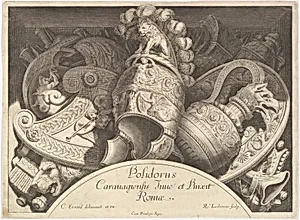
Divers Trophées (Weapon Trophies after the Façade of Palazzo Milesi in Rome)
Medium
Engraving
Dimensions
Plate: 8 13/16 x 11 15/16 in. (22.4 x 30.4 cm)
Classification
Prints|Ornament & Architecture
Department
Drawings and Prints
Museum
Metropolitan Museum of Art, New York, NY
Credit
Purchase, Phyllis D. Massar Gift, 2012
Accession Number
2012.193(3)
Rights
Public Domain
Tags
Art Historical Context
This engraving captures the lively spirit of Renaissance façade decoration through a series of martial trophies originally painted by Polidoro da Caravaggio on Rome’s Palazzo Milesi around 1520. Polidoro, celebrated for his inventive grisaille work that mimicked ancient Roman reliefs, filled the palace’s exterior with cascading arrangements of helmets, shields, spears, and bound captives—motifs that evoked both classical victory celebrations and the era’s fascination with antiquity. By 1651, when Charles Errard le fils and René Lochon translated these designs into print, the original frescoes had already become a touchstone for artists and architects across Europe. Rendered with crisp lines and subtle tonal gradations typical of seventeenth-century engraving, the plate preserves the rhythmic energy of Polidoro’s composition while making it portable. Viewers can trace the playful inclusion of animals—lions, eagles, and serpents—interwoven among the weapons, a detail that adds narrative vitality to what might otherwise read as static ornament. Such prints belonged to a growing category of “ornament and architecture” publications that allowed distant patrons and craftsmen to study Roman decorative schemes without traveling to Italy. Acquired by the Metropolitan Museum in 2012, *Divers Trophées* exemplifies how engravings served as vital bridges between past and present, carrying the grandeur of Roman-inspired imagery into new centuries and new hands.