
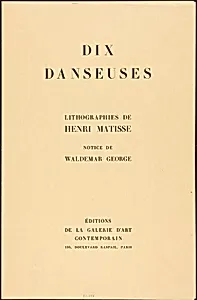
Dix Danseuses
published 1927
Medium
portfolio with ten lithographs
Classification
Portfolio
Department
CG-W
Museum
National Gallery of Art, Washington, D.C.
Credit
Rosenwald Collection
Accession Number
1953.6.85-94
Rights
Public Domain
Art Historical Context
Henri Matisse's *Dix Danseuses* (Ten Dancers), in 1927, is a captivating portfolio of ten lithographs that showcases the artist's enduring fascination with the human form in motion. As a leader of Fauvism earlier in his career, Matisse had evolved by the 1920s into a master of simplified, rhythmic compositions, often drawing inspiration from ballet and dance. This series reflects the exuberant spirit of post-World War I Paris, where performances by the Ballets Russes a cultural obsession with graceful, dynamic figures. The lithographs demonstrate Matisse's virtuosity in printmaking, using bold, flowing lines and subtle tonal variations to evoke the fluidity and joy of dancers. Unlike his vibrant oil paintings, these works emphasize contour and silhouette, making them accessible through the democratic medium of lithography—a technique that allowed for multiple editions. Housed in the National Gallery of Art's Rosenwald Collection (Department CG-W), the portfolio highlights how Matisse bridged fine art and decorative innovation, influencing modern graphic design. Visitors will delight in the playful energy of these prints, a testament to Matisse's belief that art should uplift the spirit. A true gem for admirers of early 20th-century modernism! (198 words)
About the Artist
Henri Matisse · 1869–1954
Henri Matisse (1869-1954) was a French painter, draughtsman, printmaker, and sculptor who is widely regarded as one of the most influential artists of the 20th century and the greatest colorist of his era. Born in Le Cateau-Cambresis in northern France, Matisse initially studied law before discovering his passion for art during a period of convalescence at age 20. He became the leading figure of F...