
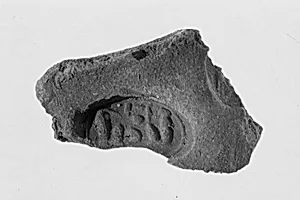
Document Sealing With Multiple Seal Impressions
Unknown Artist
ca. 1390–1352 B.C.
Medium
Mud
Dimensions
H. 2.1 cm (13/16 in.); w. 3.3 cm (1 5/16 in.); th. 1 cm (3/8 in.)
Classification
Sealing, Amenhotep III, Nebmaatre, hawk, Horus,
Period
New Kingdom
Department
Egyptian Art
Museum
Metropolitan Museum of Art, New York, NY
Credit
Rogers Fund, 1911, 1912
Accession Number
12.180.707
Rights
Public Domain
Art Historical Context
In the bustling administrative world of ancient Egypt's New Kingdom, small mud sealing—measuring just 2.1 cm high and 3.3 cm wide—ed as a vital security device for official documents. Dating to Dynasty 18 (ca. 1390–1352 B.C.), it bears multiple impressions from cylinder seals, pressed into clay to authenticate and protect papyrus scrolls or bundled records from tampering. Once the clay hardened, breaking the seal would reveal any unauthorized access, a clever low-tech safeguard in an era of vast imperial bureaucracy. Crafted from everyday mud, this unassuming artifact highlights the Egyptians' ingenuity in everyday governance during the reign of powerful pharaohs like Amenhotep III. Seals often featured hieroglyphs, royal names, or motifs of gods and scarabs, symbolizing authority and divine protection. Acquired through the Rogers Fund in 1911 and 1912, it now resides in the Metropolitan Museum of Art's Egyptian Art collection, offering a tangible glimpse into the meticulous record-keeping that sustained Egypt's golden age of empire-building. Though fragile and ephemeral, such sealings underscore the cultural emphasis on order (ma'at) and administrative precision, preserving history one impression at a time.