
Dood van Johan van Oldenbarnevelt
1684 - 1693
Medium
striking (metalworking)
Dimensions
4.8; 57.37
Rights
Public Domain
About this artwork
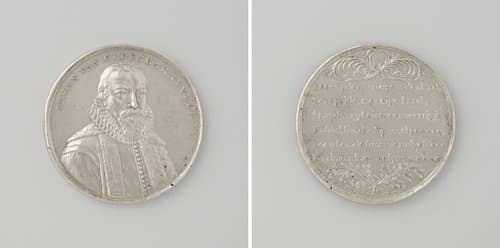
Zilveren penning. Voorzijde: borststuk man binnen omschrift. Keerzijde: opschrift onder twee in elkaar gevlochten palmtakken en twee lauwertakken, boven twee samengebonden olijftakken.
Art Historical Context
### Dood van Johan van Oldbarnevelt This exquisite silver medal, crafted by medallist Jan SmeltzingI) between 1684 and 1693, commemorates the life and tragic death of Johan van Oldbarnevelt, a figure in Dutch history. just 4.8 cm in diameter weighing 57.37 grams, the obverse features a detailed bust portrait of the statesman encircled by an inscription, capturing his dignified likeness. Smeltzing, known for his precise metalworking, employed the striking technique—hammering a die into softened silver—to achieve sharp relief and fine details, a hallmark of 17th-century Dutch medal art that blended portraiture with propaganda. The reverse side bears rich symbolism: an inscription flanked below by intertwined palm and laurel branches—evoking victory, martyrdom, and honor—and crowned above by bound olive twigs, signifying peace. Oldenbarnevelt, as Grand Pensionary of Holland, shaped the Dutch Republic's Golden Age through diplomacy and tolerance, yet was executed for treason in 1619 amid religious and political strife. Minted decades later, this medal reflects enduring partisan reverence for him as a martyr, highlighting the era's fascination with medallic art to preserve contested legacies. In the context of Dutch numismatics, Smeltzing's work exemplifies how small-scale silver pieces served as portable memorials, bridging history and personal devotion for collectors and patriots alike. A poignant artifact from the late Baroque period, it invites reflection on power, betrayal, and remembrance.