
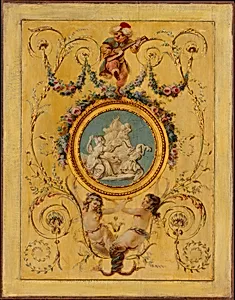
Door panel from the "Cabinet Turc" of Comte d'Artois at Versailles
Medium
Oil on oak
Dimensions
Overall (confirmed): 37 1/8 × 28 7/8 × 1 3/8 in. (94.3 × 73.3 × 3.5 cm); Overall (painted surface): 32 × 23 1/2 in. (81.3 × 59.7 cm)
Classification
Paintings-Decorative
Culture
French
Department
European Sculpture and Decorative Arts
Museum
Metropolitan Museum of Art, New York, NY
Credit
Gift of J. Pierpont Morgan, 1906
Accession Number
07.225.458a
Rights
Public Domain
Tags
Art Historical Context
This exquisite door panel, painted in 1781 by Jean-Sim Rousseau de la Rott (with possible collaboration from Jules-Hugues Rousseau once adorned the "Cabinet Turc" the Comte d'Artoisfuture King Charles X—at the opulent Palace of Versailles. Crafted during the lavish final years of the Ancien Régime, it the fashionable "Turquerie" craze, where French elites indulged in fantastical Orientalist fantasies inspired by the Ottoman Empire. The panel's oil on oak medium, with its durable wood support, was ideal for grand interior doors, blending fine art with functional decoration. Measuring about 37 x 29 inches overall, the painted surface (32 x 23½ inches) likely features lively garlands framing figures of boys, men, and women, evoking a sense of playful elegance typical of late Rococo transitioning to Neoclassicism. Rousseau de la Rottière, a specialist in such Versailles commissions, masterfully used oil's rich glazes to achieve luminous depth and texture on the oak, highlighting the era's virtuosity in decorative painting. A gift to The Metropolitan Museum of Art from J. Pierpont Morgan in 1906, this panel offers a glimpse into royal extravagance on the eve of the French Revolution, reminding us how art reflected the whims of power.
About the Artist
Jean -Siméon Rousseau de la Rottière|Jules-Hugues Rousseau ( | ) · 1743 |1747 –1806 |1820
1743–1806|1747–1820