
Doorsneden van planten
1741 - 1820
Medium
engraving
Dimensions
170; 128
Rights
Public Domain
About this artwork
verzamelaarsmerk, verso, gestempeld: Lugt 240
Art Historical Context
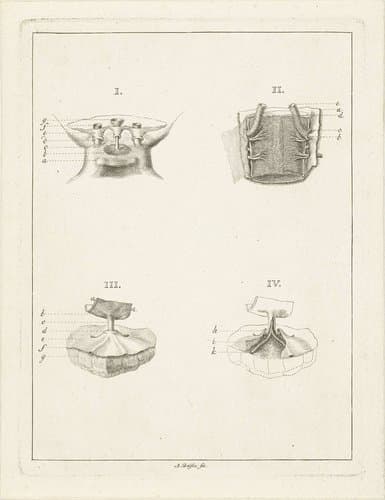
Abraham Delfos's *Doornsneden van* (Cross-Sections of Plants), created during his active years from 1741 to 1820, exemplifies the Dutch engraver's mastery in botanical illustration. This intimate engraving, measuring just 170mm by 128mm, likely captures precise transverse slices of plant structures, reflecting the Enlightenment-era fascination with natural science and microscopy. Delfos, a prominent figure in 18th-century printmaking, contributed to the era's surge in scientific documentation, where artists bridged art and botany to educate scholars and collectors. Engraving as a medium was ideal for such works, allowing for meticulous line work that conveyed textures, cellular details, and anatomical accuracy unattainable in painting. These prints were highly valued for their reproducibility, disseminating knowledge from microscopes to wider audiences amid growing herbariums and botanical gardens in the Netherlands. On the verso, a collector's mark stamped Lugt 240 hints at the artwork's esteemed provenance, linking it to a distinguished 18th- or 19th-century collector. This small yet significant piece invites visitors to appreciate how Delfos transformed scientific observation into enduring art, blending precision with aesthetic elegance.
About the Artist
Abraham Delfos · 1731–1820
Abraham Delfos (1731–1820) was a distinguished Dutch painter, draughtsman, and engraver whose nearly nine-decade life spanned much of the 18th century and extended into the early 19th, making him a bridge between the late Dutch Golden Age tradition and the emergence of modern Dutch art. Born in Leiden on March 8, 1731, Delfos dedicated his career to the meticulous craft of reproductive engraving, ...