
Double-Barreled Wheellock Pistol Made for Emperor Charles V (reigned 1519–56)
ca. 1540–45
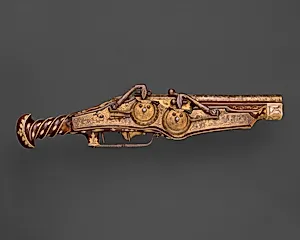
Medium
Steel, gold, wood (cherry), staghorn
Dimensions
L. 19 3/8 in. (49.2 cm); L. of upper barrel 10 in. (25.4 cm); L. of lower barrel 7 5/8 in. (19.4 cm); Cal. of each barrel .46 in. (11.7 mm); Wt. 5 lb. 10 oz. (2550 g)
Classification
Firearms-Pistols-Wheellock
Culture
German, Munich
Department
Arms and Armor
Museum
Metropolitan Museum of Art, New York, NY
Credit
Gift of William H. Riggs, 1913
Accession Number
14.25.1425
Rights
Public Domain
Tags
Art Historical Context
This exquisite double-barreled wheock pistol, crafted around 1540–45 by Munich gunsmiths Ambrosiuslich and Peter Peck, made for Emperor Charles V, the powerful Holy Roman Emperor whose reign1519–56) spanned Europe’s turbulent Renaissance era. Weighing a hefty 5 pounds 10 ounces, with steel barrels of 10 and 7⅝ inches, it exemplifies early modern firearms technology. The wheellock mechanism innovative pyrotechnic ignition using a spinning wheel to strike flint—was a leap forward from matchlocks, enabling reliable firing even on horseback, ideal for the emperor’s hunting pursuits. Luxuriously appointed with gold inlays, cherry wood stocks, and staghorn grips, the pistol’s surfaces likely feature intricate engravings of horses, deer, dogs, and hunting scenes, blending functionality with artistry. Produced in Munich, a hub of German Renaissance metalwork, it reflects the era’s fusion of warfare, sport, and opulence—firearms as status symbols for nobility. Today, this rare survivor graces the Metropolitan Museum of Art’s Arms and Armor Department, gifted by William H. Riggs in 1913, offering a glimpse into 16th-century innovation and imperial splendor.
About the Artist
Ambrosius Gemlich|Peter Peck · 1495–1575
**Ambrosius Gemlich (ca. 1500 – after 1542)** was a masterful German etcher, or *Ätzmaler*, renowned for his intricate acid-etchings on blades, firearms, and armor during the Renaissance. Active primarily in Munich and Landshut from around 1520 to 1550, Gemlich transformed utilitarian weapons into exquisite art objects through his pioneering use of etching techniques on steel. His designs featured...