
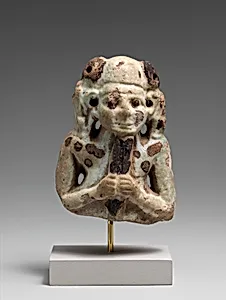
Double-flute player
Unknown Artist
ca. 945–525 B.C.
Medium
Faience
Dimensions
H. 6 × W. 4.5 × D. 2.9 cm (2 3/8 × 1 3/4 × 1 1/8 in.)
Classification
Statuette fragment, double-flute player
Period
Third Intermediate Period–Late Period
Department
Egyptian Art
Museum
Metropolitan Museum of Art, New York, NY
Credit
Gift of Elisha Dyer, in memory of George R. Dyer, 1941
Accession Number
41.6.7
Rights
Public Domain
Tags
Art Historical Context
This charming faience figurine, created between roughly 945 and525 B.C. during Egypt’s Third Intermediate Late Periods, captures a musician playing a double flute. Standing just over two inches tall, the small sculpture belongs to a long Egyptian tradition of representing daily life and ritual activities in durable, brightly glazed materials. Faience, prized for its vibrant turquoise hues that evoked the life-giving Nile, was commonly used for votive objects and personal items during Dynasties 22–26, a time when music remained central to both temple ceremonies and household entertainment. The figure’s compact form and detailed modeling highlight the skill of Egyptian artisans in working with this quartz-based medium. Double-flute players appear frequently in tomb reliefs and small sculptures, suggesting their role in invoking joy, warding off evil, or accompanying offerings to the gods. Though the artist remains unknown, the piece reflects the period’s emphasis on accessible, portable art that connected ordinary Egyptians with sacred and secular music-making. Acquired by the Metropolitan Museum of Art in 1941 as a gift in memory of George R. Dyer, this delicate artifact offers visitors a vivid glimpse into the sounds and artistry of ancient Egyptian culture.