
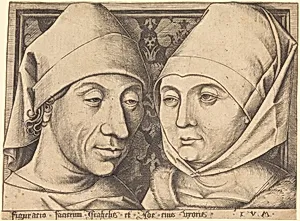
Double Portrait of Israhel van Meckenem and His Wife Ida
c. 1490
Medium
engraving on laid paper
Dimensions
sheet (trimmed to plate mark): 13 x 17.5 cm (5 1/8 x 6 7/8 in.)
Classification
Department
CG-E
Museum
National Gallery of Art, Washington, D.C.
Credit
Rosenwald Collection
Accession Number
1943.3.99
Rights
Public Domain
Art Historical Context
In this charming double portrait from around 1490, engraver Israhel van Meckenem presents himself seated beside his wife, Ida, a quiet moment of companionship Rendered as a small engraving on laid paper, the work captures the couple with delicate lines and careful attention to their clothing and expressions. As both artist and subject, van Meckenem creates one of the earliest known self-portraits in print form, offering a personal touch rarely seen in art of this period. Engraving allowed images to be reproduced and shared across Europe at a time when printmaking was still emerging as a major artistic medium. This intimate scene stands out for its everyday warmth, transforming a technical print into a lasting record of marital partnership and the artist’s own identity. Preserved in the National Gallery of Art’s Rosenwald Collection, the engraving highlights the growing role of prints in making art more accessible while preserving personal stories from the late fifteenth century.
About the Artist
Israhel van Meckenem · 1435–1503
Israhel van Meckenem (c. 1445–1503), also known as Israhel van Meckenem the Younger, was a pioneering German engraver and goldsmith based in Bocholt, near the Dutch border, renowned as the most prolific printmaker of the fifteenth century. Born into a family possibly of Dutch origin, he was the son of Israhel van Meckenem the Elder, a goldsmith who settled in Bocholt in 1457. He trained initially ...