
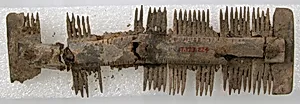
Double-Sided Comb
Unknown Artist
7th century
Medium
Bone, iron pins
Dimensions
Overall: 5 5/16 x 1 5/8 x 1/2 in. (13.5 x 4.2 x 1.3 cm)
Classification
Bone
Culture
Frankish
Department
Medieval Art
Museum
Metropolitan Museum of Art, New York, NY
Credit
Gift of J. Pierpont Morgan, 1917
Accession Number
17.193.224
Rights
Public Domain
Art Historical Context
This exquisite double-sided comb, crafted in the 7th century by an unknown Frankish artisan, offers a glimpse into everyday life the early medieval Merovingian period. Made from bone with iron pins, it measures a compact 5 5/16 x 1 5/8 x 1/2 inches, perfectly suited for personal grooming. The Frankish culture, centered in what is now France and Germany, produced such utilitarian objects that blended functionality with fine craftsmanship, reflecting a society transitioning from late antiquity to the Middle Ages. The comb's double-sided design—likely one side with finer teeth for styling hair and the other coarser for removing lice—highlights practical innovations in hygiene amid a time when cleanliness was a marker of status. Bone, a readily available and workable medium, was meticulously carved, showcasing the skill of Frankish boneworkers who transformed animal remains into durable tools. Iron pins added strength, underscoring early metallurgical expertise. Now housed in the Metropolitan Museum of Art's Medieval Art department, this comb was a gift from J. Pierpont Morgan in 1917. It reminds us that even humble artifacts preserve the ingenuity and daily rhythms of ancient peoples, inviting us to ponder the hands that once held it.