
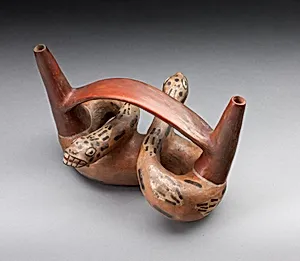
Double-Spout Bridge Vessel in the form of a Double-Headed Serpent
600–1000
Medium
Ceramic and pigment
Dimensions
13.5 × 19.7 cm (5 5/16 × 7 3/4 in.)
Classification
earthenware
Department
Arts of the Americas
Museum
Art Institute of Chicago
Accession Number
91455
Rights
Public Domain
Art Historical Context
This striking Double-Spout Bridge Vessel, by artisans of the Tiwanaku culture 600 and 1000 CE, embodies the ingenuity of ancient Andean pottery. Shaped as a double-headed serpent, the earthenware piece measures 13.5 × 19.7 cm and is adorned with pigments that once highlighted its sinuous form. Housed in the Art Institute of Chicago's Arts of the department, it exemplifies the Tiwanaku's mastery of ceramic vessels designed for practical use—pouring liquids through twin spouts connected by a bridge, preventing spills during rituals or daily life. Tiwanaku, a powerful pre-Columbian civilization centered near Lake Titicaca in present-day Bolivia, flourished as a hub of trade, religion, and innovation. Their ceramics often featured zoomorphic motifs like serpents, symbolizing potent forces in Andean cosmology, such as water, fertility, and the supernatural realm. The double-headed design amplifies this mysticism, suggesting duality or guardianship. Artistically, the vessel's modeled clay and painted details reveal sophisticated techniques: coils built into a seamless form, fired for durability, and enhanced with mineral pigments for vivid expression. A testament to Tiwanaku's enduring legacy, it invites visitors to ponder the blend of utility and spirituality in everyday objects from a lost empire.