
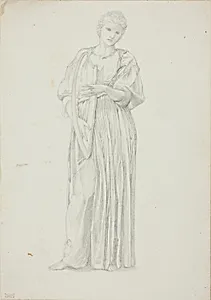
Draped Figure of Woman Playing on a Harp
c. 1873–77
Medium
Graphite on ivory wove paper
Dimensions
25.3 × 17.8 cm (10 × 7 1/16 in.)
Classification
graphite
Department
Prints and Drawings
Museum
Art Institute of Chicago
Accession Number
78935
Rights
Public Domain
Art Historical Context
In the tranquil gallery of Prints and Drawings at the Art of Chicago resides *Draped Figure of Woman Playing on a Harp a delicate graphite drawing on ivory wove paper by Edward Burne-Jones, around 1873–77. Measuring just 25.3 × 17.8 cm, this intimate study captures a graceful, ethereal woman draped in flowing robes, her fingers poised on the harp strings in a moment of musical reverie. Burne-Jones, a leading figure in the Pre-Raphaelite Brotherhood and later the Aesthetic Movement, was renowned for his dreamlike depictions of idealized beauty drawn from medieval and classical myths. This work exemplifies Burne-Jones's mastery of graphite as a medium, allowing for exquisite line work and subtle tonal modeling that evoke a sense of otherworldly serenity. The ivory wove paper enhances the luminous quality, mimicking the soft glow of his oil paintings. Created during a prolific period when he collaborated with William Morris on decorative arts and book illustrations, the drawing likely served as a preparatory sketch, reflecting the era's fascination with music, femininity, and escapism amid Victorian industrialization. Visitors will appreciate how this piece bridges Burne-Jones's fine art and design worlds, inviting contemplation of harmony between human form and melody—a timeless Pre-Raphaelite ideal.
About the Artist
Sir Edward Burne-Jones · 1833–1898
Edward Coley Burne-Jones was born on 28 August 1833 in Birmingham, the son of a frame-maker, and lost his mother within a week of his birth. He attended King Edward VI Grammar School and the Birmingham School of Art before proceeding to Exeter College, Oxford, in 1852, intending to study theology. At Oxford he formed a lifelong friendship with William Morris, and the two young men became intoxicat...