
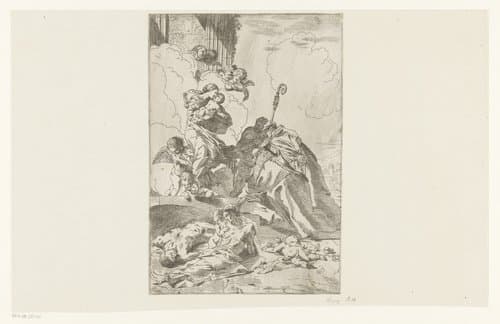
Drie heiligen als voorspraak voor slachtoffers van de pest
in or after 1630 - in or after 1631
Medium
etching
Dimensions
185; 267
Rights
Public Domain
About this artwork
blad: hoogte 267 mm (binnen plaatrand afgesneden) x breedte 185 mm (binnen plaatrand afgesneden)
Art Historical Context
This poignant etching, titled *Drie heiligen alsspraak voor slachtoffers van pest* ("Three Saints as Intercessors Victims of the Plague"), created anonymously in or after 1630–1. Measuring 267 mm high by 185 mm wide ( the plate marks), it exemplifies the intimate scale of 17th-century Dutch printmaking. Etching, a technique using acid to bite intricate lines into a metal plate, allowed for detailed reproductions that were affordable and widely circulated, making religious imagery accessible to households amid crisis. Created during a devastating plague outbreak in the Dutch Republic—such as the epidemic ravaging Amsterdam around 1630—this work reflects profound cultural anxieties. Saints like Rochus, Sebastianus, and often Rosalia were invoked as protectors against pestilence, their intercessory roles visualized to offer spiritual solace and hope. Anonymous prints like this served as votive aids, pinned to walls or carried as talismans, blending art with popular devotion in the Protestant north where Catholic imagery persisted underground. Artistically, the etching's fine lines capture expressive figures and symbolic motifs, highlighting the medium's rise in the Dutch Golden Age for narrative depth on a modest budget. Today, it reminds us of art's power to console in times of collective suffering.
About the Artist
anonymous
In the vast tapestry of art history, "Anonymous" stands not as a singular individual but as a collective designation for countless unidentified creators whose works have endured across millennia. These artists, spanning prehistoric cave painters to medieval illuminators and folk craftsmen, produced the foundational layers of human visual culture. Prior to the Renaissance, when individual fame emer...