
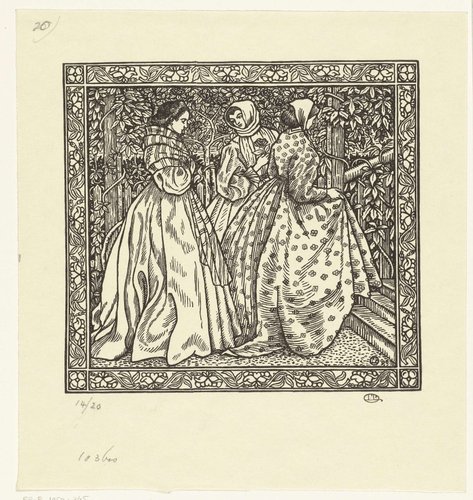
Drie vrouwen in een tuin
1896
Medium
wood engraving
Dimensions
142; 132
Rights
Public Domain
About this artwork
stamp: Lugt 1756b
Art Historical Context
**Drie vrouwen in een tuin (Three Women in a Garden)** Lucien Pissarro, 1896 Wood engraving, 132 × 142 mm Created in 1896, *Drie vrouwen in een tuin* captures a serene garden scene with three women, rendered in the precise, delicate lines of wood engraving. Lucien Pissarro, son of Impressionist master Camille Pissarro, was a multifaceted artist who bridged French Post-Impressionism with the British Arts and Crafts movement. By the 1890s, he had settled in England, where he pioneered fine wood engravings, often collaborating with his wife Esther on the Eragny Press to produce artistically unified illustrated books. Wood engraving, distinct from woodcut, involves incising fine details into the dense end-grain of boxwood blocks, allowing for intricate textures and tonal effects akin to drawing. This small-scale print (just over 5 inches square) exemplifies Lucien's skill in translating impressionistic light and atmosphere into black-and-white precision, evoking the leisurely garden motifs popular in fin-de-siècle art. Bearing the collector's stamp Lugt 1756b, this work highlights Pissarro's enduring legacy in printmaking, bridging painting and graphic arts during a time when such techniques revitalized book illustration and fine art reproduction. A charming glimpse into everyday beauty through masterful craftsmanship.
About the Artist
Lucien Pissarro · 1863–1944
Lucien Pissarro (1863–1944) stands as a unique bridge between French Impressionism and British modernism, successfully navigating multiple artistic movements and mediums throughout his seven-decade career. Born in Paris as the eldest son of the celebrated Impressionist painter Camille Pissarro, Lucien inherited not only his father's artistic talent but also his commitment to innovation and experim...