
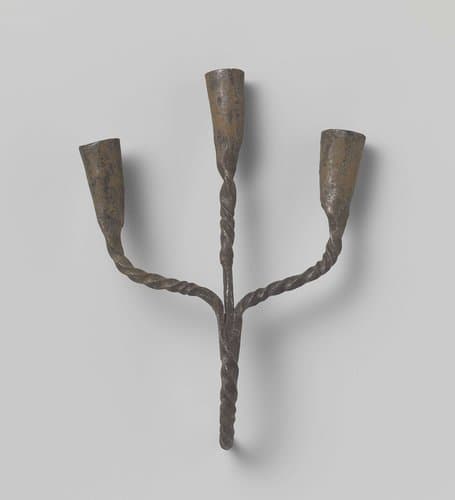
Driearmig fragment van een hang- of wandkandelaar
c. 1750 - c. 1850
Medium
forging
Dimensions
17; 22
Rights
Public Domain
About this artwork
height 22 cm x width 17 cm
Art Historical Context
This intriguing fragment, titled *Driearmig fragment een hang- of wandandelaar* (Three-Armed Fragment of a Hanging or Candelabrum), to approximately 1750–1850. Measuring just 22 cm high and 17 cm wide, it offers a glimpse into the utilitarian artistry of pre-industrial Europe, likely from the Netherlands a neighboring region where Dutch craftsmanship thrived. As an anonymous work, it exemplifies the skilled labor of local blacksmiths who produced essential household and ecclesiastical items before widespread electricity. Crafted through forging—a labor-intensive technique of heating iron and shaping it by hammer on an anvil—this piece highlights the durability and elegance achievable with basic metallurgy. The three-armed design suggests it once held candles to illuminate homes, taverns, or places of worship, casting a warm glow during long evenings. Such candelabra were status symbols for the emerging middle class, blending functionality with subtle ornamentation. Though incomplete, this survivor underscores the everyday cultural importance of metalwork in the 18th and 19th centuries, when lighting defined social spaces. Visitors can appreciate how anonymous artisans contributed to the tactile beauty of daily life, preserving a spark of history in every curve.
About the Artist
anonymous
In the vast tapestry of art history, "Anonymous" stands not as a singular individual but as a collective designation for countless unidentified creators whose works have endured across millennia. These artists, spanning prehistoric cave painters to medieval illuminators and folk craftsmen, produced the foundational layers of human visual culture. Prior to the Renaissance, when individual fame emer...