
Drop-front desk (secrétaire à abattant or secrétaire en cabinet)
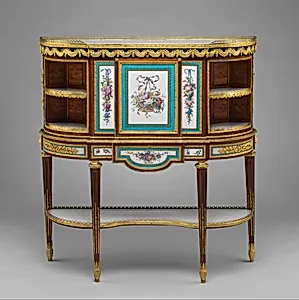
Medium
Oak veneered with tulipwood, amaranth, holly, and sycamore; six Sèvres soft-paste porcelain plaques and two painted tin plaques; gilt-bronze mounts; marble shelves; moiré silk
Dimensions
43 3/8 x 40 1/2 x 12 7/8 in. (110.1 x 102.9 x 32.7cm)
Classification
Woodwork-Furniture
Culture
French, Paris and Sèvres
Department
European Sculpture and Decorative Arts
Museum
Metropolitan Museum of Art, New York, NY
Credit
Gift of Mr. and Mrs. Charles Wrightsman, 1976
Accession Number
1976.155.110
Rights
Public Domain
Art Historical Context
Step into the opulent world of 18th-century French aristocracy with this exquisite drop-front desk, or *secrétaire à abattant crafted around 1776 by master cabinetmaker Martin Carlin in collaboration with Edme Françoisillat père and the renowned Sèvres Manuf. Housed in the Metropolitan Museum of Art's European Sculpture and Decorative Arts department, this piece exemplifies the Louis XVI neoclassical style, blending refined symmetry with motifs of garlands and flowers that evoke the era's fascination with antiquity and nature. Constructed from oak veneered in luxurious tulipwood, amaranth, holly, and sycamore, the desk features six precious Sèvres soft-paste porcelain plaques—soft-paste being a prized innovation for its creamy translucency—alongside two painted tin plaques, ornate gilt-bronze mounts, marble shelves, and shimmering moiré silk. These elements create a harmonious interplay of materials, where the porcelain's delicate floral designs contrast with the gleaming bronze and vibrant woods, showcasing virtuoso *marcquetry* (inlaid woodwork) techniques. A gift from Mr. and Mrs. Charles Wrightsman in 1976, this compact yet grand furniture (43 3/8 x 40 1/2 x 12 7/8 in.) was designed for intimate writing and display in Parisian salons. It highlights the collaborative genius of Paris and Sèvres artisans, symbols of pre-Revolutionary luxury that catered to elite tastes before the upheavals of 1789.