
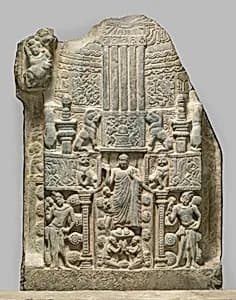
Drum panel depicting a stupa with the Buddha’s descent from Trayastrimsa Heaven
Unknown Artist
second half of the 3rd century
Medium
Limestone
Dimensions
H. 48 in. (121.9 cm); W. 29 3/4 in. (75.6 cm); D. 6 3/4 in. (17.1 cm); Wt. 723.3 lbs. (328.1 kg)
Classification
Sculpture
Culture & Period
India (Andhra Pradesh, Nagarjunakonda) · Ikshvaku
Department
Asian Art
Museum
Metropolitan Museum of Art, New York, NY
Credit
Rogers Fund, 1928
Accession Number
28.31
Rights
Public Domain
Tags
Art Historical Context
This striking limestone drum panel, carved the second half of the 3rd century during the Ikshvaku, hails from the ancient Buddhist site of Nagarjunakonda in Andhra Pradesh India. Measuring nearly 4 feet tall and weighing over 700 pounds, it formed part of a stupa's cylindrical base, a sacred mound enshrining Buddhist relics. The relief vividly depicts the Buddha's miraculous descent from Trayastrim Heaven—a pivotal event where he returns to earth after preaching to his mother, Maya, accompanied by deities and flanked by guardian lions. In Early Andhra art, such narrative panels were masterful storytelling tools, blending intricate carving with architectural grandeur to educate pilgrims. Nagarjunakonda was a thriving hub of Mahayana Buddhism under the Ikshvaku dynasty, whose royal patronage fueled elaborate stupa complexes. This piece exemplifies the region's sculptural prowess: deeply undercut figures emerge dynamically from the stone, capturing motion and divinity amid floral motifs and celestial architecture. Its presence at the Metropolitan Museum of Art (Rogers Fund, 1928) offers a window into South India's vibrant Buddhist heritage, where art bridged the heavens and earth, inspiring devotion for centuries.