
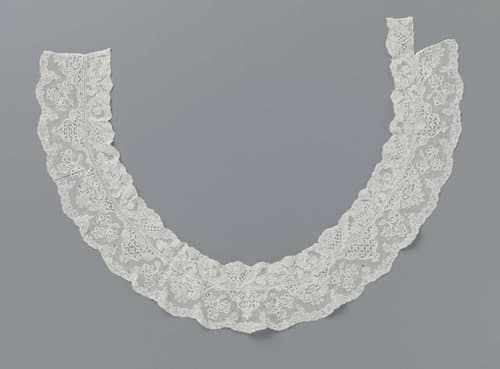
Dubbele kraag van kloskant met berg en dal-lijn
ca. 1740
Medium
bobbin lace
Dimensions
77; 5; 3; 9.5
Rights
Public Domain
About this artwork
On loan from the Koninklijke Verzamelingen
Art Historical Context
Step into the elegance of 18th-century with this exquisite *Dubbele kraag van klos met berg en dal-* (Double Collar of Bobbin Lace with and Valley Line), crafted around 1740 by an anonymous artisan. Measuring a slender 77 cm long by 3 cm wide, this delicate bobbin lace collar exemplifies the pinnacle of lace-making skill from the Low Countries, Flanders or the Netherlands, where such techniques flourished. On loan from the Koninklijkezamelingen (Royal), it whispers of royal or elite wardrobes, where lace adorned the nobility as a mark of refinement and wealth. Bobbin lace, or *kloskant*, is created by twisting and intertwining fine threads held on wooden bobbins over a patterned pillow, allowing for intricate, durable designs. The standout "berg en dal-lijn" motif—a rhythmic wavy line evoking mountains and valleys—adds a playful, naturalistic flourish typical of Dutch lace patterns from this Rococo-influenced era. Such collars framed the face in double-layered opulence, enhancing portraits and formal attire amid Europe's lace mania. This piece highlights lace's cultural role as both art and status symbol, bridging craftsmanship and couture. Its survival offers a tactile glimpse into a time when handmade textiles rivaled jewels in prestige, inviting us to appreciate the unseen labor behind fleeting fashion.
About the Artist
anonymous
In the vast tapestry of art history, "Anonymous" stands not as a singular individual but as a collective designation for countless unidentified creators whose works have endured across millennia. These artists, spanning prehistoric cave painters to medieval illuminators and folk craftsmen, produced the foundational layers of human visual culture. Prior to the Renaissance, when individual fame emer...