
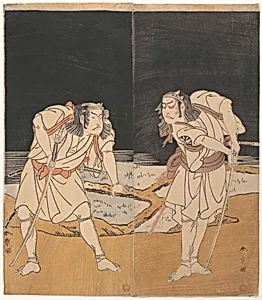
Duel Scene from the Kabuki Drama, "A Soga Pattern Dyed to Order" (Ōatsurae-zome Soga Hinagata)
Medium
Diptych of woodblock prints (nishiki-e); ink and color on paper
Dimensions
A: H. 12 11/16 in. (32.2 cm); W. 5 5/8 in. (14.3 cm) B: H. 12 13/16 in (32.5 cm); W. 5 9/16 in. (14.1 cm)
Classification
Prints
Culture & Period
Japan · Edo period (1615–1868)
Department
Asian Art
Museum
Metropolitan Museum of Art, New York, NY
Credit
Purchase, Joseph Pulitzer Bequest, 1918
Accession Number
JP399
Rights
Public Domain
Tags
Art Historical Context
Step into the vibrant world of Edo-period Japan with Katsukawa Shunshō'sDuel Scene from the Kabuki Drama, "A Soga Pattern Dyed to Order"* (1774). This dynamic diptych of nishiki-e woodblock captures a tense swordfight from a popular Kabuki play, drawing on the legendary tale of the Soga brothers revenge. Shunshō, a master of the ukiyo-e and founder of the Katsukawa school specialized in yakusha-e—portraits of Kabuki actors—that brought theater stars to life for everyday viewers. Printed in vivid ink and color on paper, the nishiki-e technique mimics luxurious brocade fabrics through layered colors and precise woodblock carving, making high art accessible in affordable sheets. Each panel measures about 12 inches tall, designed to join seamlessly for immersive storytelling. Created during the Edo period (1615–1868), when Kabuki flourished in urban pleasure districts, this work reflects Japan's booming print culture, where fans collected images of their favorite performers mid-action. Housed in the Metropolitan Museum of Art, this piece highlights the artistry of frozen drama—actors frozen in fierce stances, swords gleaming—offering a window into 18th-century Japan's love for spectacle, heroism, and the thrill of the stage.
About the Artist
Katsukawa Shunshō 勝川春章 (Japanese) · 1726 –1792
Japanese, 1726–1792