
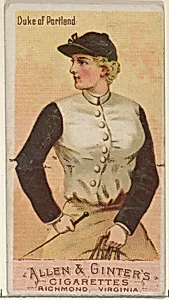
Duke of Portland, from the Racing Colors of the World series (N22a) for Allen & Ginter Cigarettes
1888
Medium
Commercial color lithograph
Dimensions
Sheet: 2 3/4 x 1 1/2 in. (7 x 3.8 cm)
Classification
Prints|Ephemera
Department
Drawings and Prints
Museum
Metropolitan Museum of Art, New York, NY
Credit
The Jefferson R. Burdick Collection, Gift of Jefferson R. Burdick
Accession Number
63.350.201.22.32
Rights
Public Domain
Tags
Art Historical Context
Step into the vibrant world of 19th-century ephemera with *Duke of Portland, from the Racing Colors of the World series (N22a)*, a diminutive commercial color lithograph produced by Allen & Ginter in 1888. This tiny card, measuring just 2 3/4 x 1 1/2 inches, was one of many inserted into cigarette packs as collectible trade cards, sparking a craze among enthusiasts. Part of a series showcasing international horse racing silks—those colorful jockey uniforms symbolizing stables like the Duke of Portland's—it captures the elegance and excitement of the turf in vivid chromolithography, a technique that layered up to 30 colors for stunning, affordable mass production. Allen & Ginter, pioneering tobacco marketers, transformed advertising into art, blending sport, fashion, and celebrity. Here, profile tags highlight women as athletes and jockeys, reflecting rare glimpses of female participation in a male-dominated sport during the Gilded Age. Though women jockeys were exceptional, these cards celebrated their prowess alongside equine stars, bridging high society racing with everyday collectors. Today, preserved in the Metropolitan Museum of Art's Jefferson R. Burdick Collection, this ephemera reveals how commercial prints democratized visual culture, turning a promotional gimmick into a snapshot of 1880s leisure and innovation. A delightful reminder of racing's global allure!
About the Artist
Allen & Ginter
Allen & Ginter, the pioneering American tobacco firm based in Richmond, Virginia, emerged around 1880 from the partnership of John F. Allen and Lewis Ginter, evolving from Allen's earlier John F. Allen & Company. Allen retired in 1882, succeeded by John Pope, yet the brand endured under Ginter's leadership, employing over 1,100 workers—mostly women—for hand-rolled cigarettes by 1886. Ginter, a Dut...