
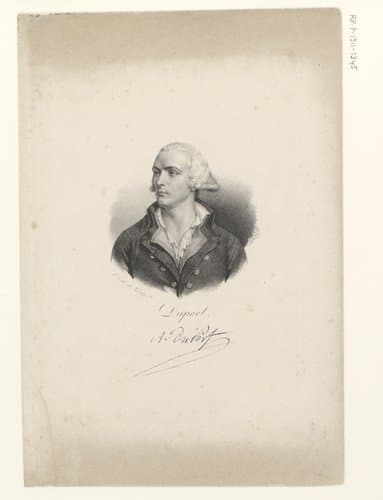
Duport
in or after 1818 - in or before 1842
Medium
lithography
Dimensions
254; 173
Rights
Public Domain
About this artwork
lithografie
Art Historical Context
Welcome to our virtual gallery, where we explore the elegant world of early 19th-century lithography.Duport*, created by the anonymous artist veuve Delpech (Naudet) between 1818 and 1842, measures a modest 254 mm high by 173 mm wide. Produced in Paris, this lithograph exemplifies the workshop of Mme. Delpech, a widow who continued her husband's pioneering lithographic press after his death. Her studio became renowned for affordable, high-quality prints, capturing the likenesses of notables from politics, arts, and society. Lithography, invented just two decades earlier by Alois Senefelder, revolutionized printmaking with its crayon-drawn technique on limestone slabs. Grease-based marks repelled water during inking, yielding crisp, nuanced lines ideal for portraits like this one. During France's Restoration and July Monarchy eras, such prints democratized access to imagery, bridging fine art and popular culture without the high costs of engraving. Though details on the sitter "Duport" remain elusive—possibly referencing a contemporary figure—the artwork highlights lithography's cultural bloom. It invites us to appreciate how everyday visitors could own sophisticated art, preserving personal and historical stories in an accessible form. A charming window into a transformative medium!